
The Hebrew word נִקְפָּה (nikpáh), translated as rope, girdle, or braided cord, derives from the triliteral root נק״ף (naqaf). The semantic field points to the act of circling, surrounding, or encircling. In Scripture, naqaf describes the movement of going around a city (Joshua 6:3) and also the gesture of forming a ritual circle. The image is always the same: to draw a perimeter that distinguishes, consecrates, and protects, mostly popularized by the ritualistic magic circle. The verb suggests the birth of a Sacred space, the moment when something is delimited in order to contain the invisible.
The rope is born from this gesture of encirclement. Before any doctrine or oath, the initiate is surrounded. The circle is not drawn on the ground, but rather drawn upon the body. And the body itself becomes a boundary. The rope corresponds to the instant when the profane is set apart from the world. It is a return to primordial nakedness, that state in which the soul is treated as material for the Work. The neophyte receives the rope as a demarcation: it marks the beginning of the operative space of transmutation.
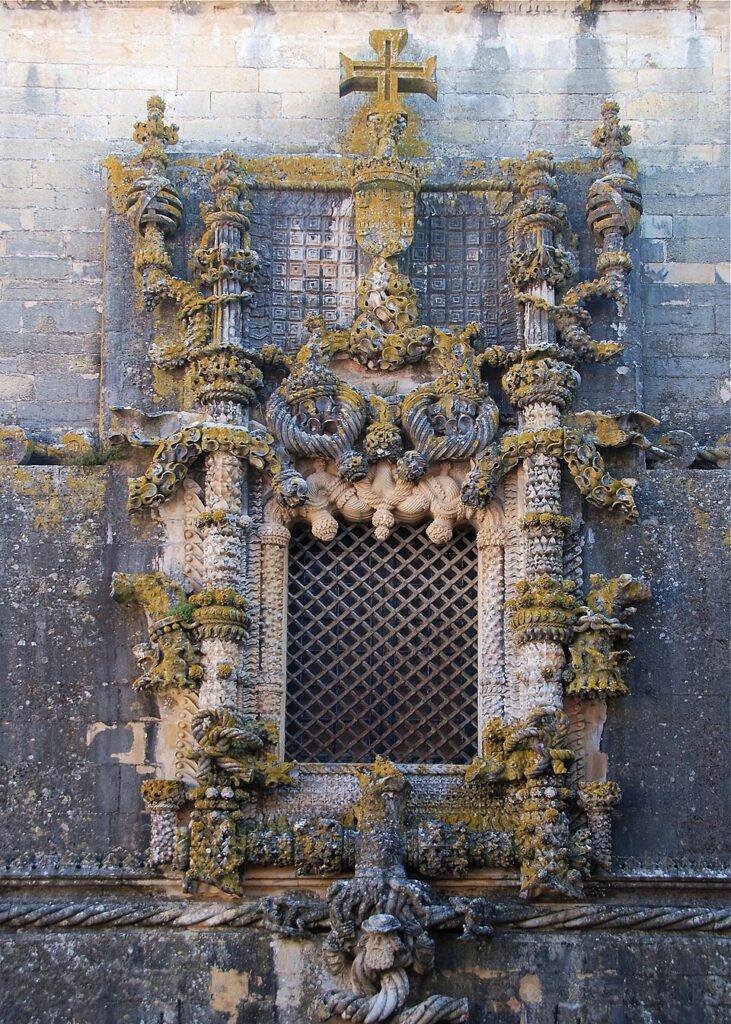
This symbolism finds a remarkable architectural echo in the Manueline style, the initiatory art associated with the Order of Christ in early sixteenth-century Portugal. The central motif of that style is precisely the rope, carved, braided, coiled around columns, portals, and windows. During the reign of King Manuel I, countless pre-existing and new churches, towers, and fortresses were “circumscribed” anew by this ornament: the rope wound around their openings as if re-consecrating them to a higher purpose.
In Hermeticism, the rope is also the inverted umbilical cord: the bond that connects not to the biological mother, but to the omphalos of the spiritual Matrix. It restores the primordial tie between microcosm and macrocosm. For this reason, the rope is always ambivalent. It represents connection and separation. It binds the initiate to the invisible college of those who have been encircled before him, and it severs him from the mundane clamour that cannot yet accompany him.
In symbolic and numerological terms, the value of נִקְפָּה (nikpáh) confirms with remarkable precision its initiatory significance. In Gematria, it equals 235, which, when reduced by the Pythagorean method, becomes 2 + 3 + 5 = 10, and then 1 + 0 = 1. The number 10 corresponds to the ten Sefiroth of the Tree of Life, the Pythagorean Tetraktys, the structure of emanation through which the One unfolds into the Ten, and Spirit crystallises into matter. Ten is also linked to Arcanum X of the Tarot, The Wheel of Fortune, sigil of circular movement, of the turning of destiny, of the perpetual alternation between above and below.
This same principle of cyclical enclosure finds its perfect emblem in the Ouroboros, the serpent that devours its own tail, sealing the Work within its eternal circumference. When its head and tail are read as the Lunar Nodes, Caput Draconis (the North and Benefic Node) and Cauda Draconis (the South and Malefic Node), the image acquires an unmistakably initiatory dimension: the eternal beginning and eternal rebeginning that bind Spirit to matter and vice-versa.
In geomancy, this polarity is rendered with striking precision. Caput Draconis, the Dragon’s Head, possesses Fire as its only passive line. Almost often the most active of elements, Fire here descends, as it is the moment when celestial energy sinks into matter, igniting incarnation itself. For this reason, Caput Draconis is associated with the Element of Earth, the densest and most manifest of all, symbolising the Spirit’s deliberate descent into form.
Cauda Draconis, the Dragon’s Tail, is its perfect reversal. It bears Earth as its only passive line, and its movement is one of release, of return. The forms that once enclosed are dissolved and the dense becomes transparent. Cauda Draconis corresponds to the Element of Fire, the ascensional flame that carries consciousness upward, dissolving the crust of materiality.
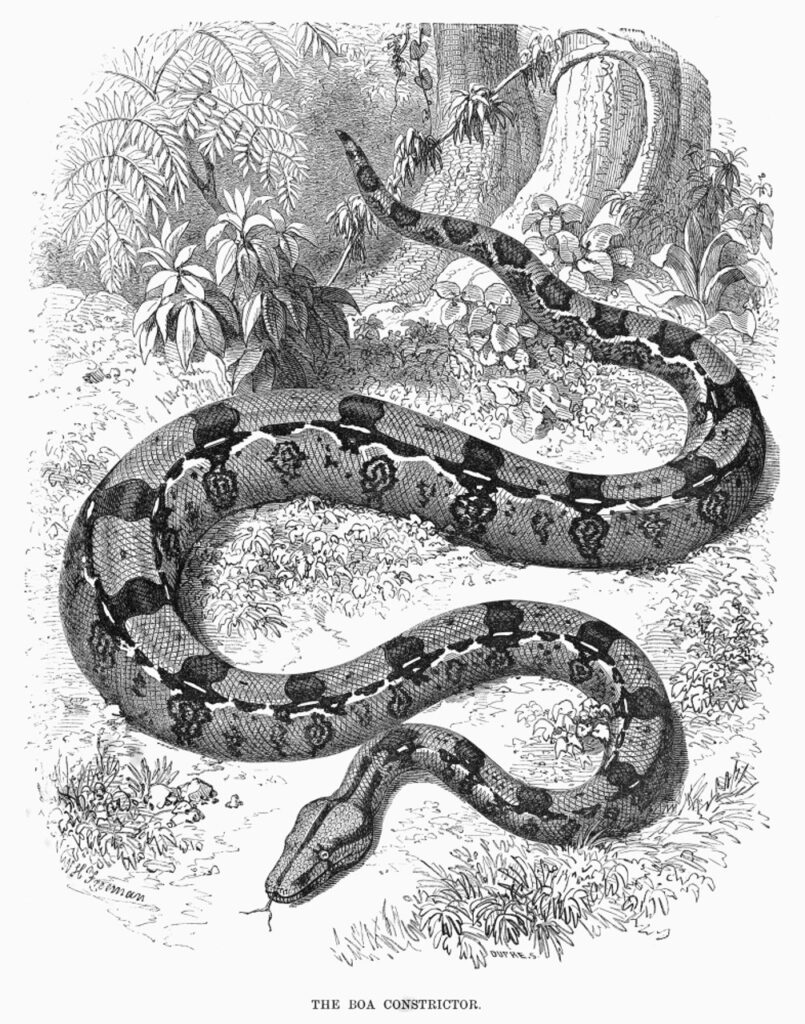
In nature, this mystery takes form in the Boa constrictor, the living Ouroboros of the visible world. It is a serpent that does not kill using venom, preferring rhythm: tightening its coils in pulses that match the breath of its prey, crushing it slowly. The victim dies when its breath ceases, when Spirit withdraws from matter. At the level of symbol, this same act is the archetype of transformation. The constriction is the passage through which Spirit is separated from density, the initiatory tension through which life changes state.
But the final reduction of 10 to 1 unveils the mystery of return to the Source: Kether, the Crown, the indivisible point from which the four forces of the Tetragrammaton (Yod, He, Vau, He) emanate, represented in the four Aces of the Tarot. The zero implicit in this ten (1+0) is the breath of the Fool, the boundless Spirit that pervades and animates all creation. The rope, whose very name encodes this numerical pattern, becomes the thread that connects Kether (1) to Malkuth (10), the descent of Spirit into form and the ascent of form back into Spirit.
Kύριε ελέησον