The letter Tau (Τ) occupies the nineteenth place in the Greek alphabet and contains one of the most ancient seals of consecration in the sapiential tradition. From the prophets to the initiates, its cross-shaped form is a sign of election, boundary, and passage. In Ezekiel 9:4, the Lord commands the angel: “Go through the city, through Jerusalem, and mark a tau upon the foreheads of the men who sigh and cry for all the abominations that are done within it.” Tau is the invisible mark of the righteous, the emblem of the soul preserved amid judgement, a sign of recognition among the children of light. The early Fathers saw in this sign the foreshadowing of the Cross of Christ, the meeting of the Alpha of creation with the Omega of redemption, the vestige of unity between beginning and end.
In the Tarot, nineteen corresponds to the Sun in the Major Arcana, a Divine card that represents the active and emissive principle of י (Yod) in the seventh and final ternary. It forms the upper vertex of that concluding triangle, whose base is completed by Judgement (Arcana XX), the receptive principle of ה (He) and the Fire of ש (Shin), and consummated in the World (Arcana XXI), where Spirit stands at the centre surrounded by the four elements, the image of universal reintegration. The Sun, which follows the Moon in the cards, marks the turning point of the cycle, the moment of Metanoia, when the head turns eastward, toward the inner Light of Consciousness within the Temple.
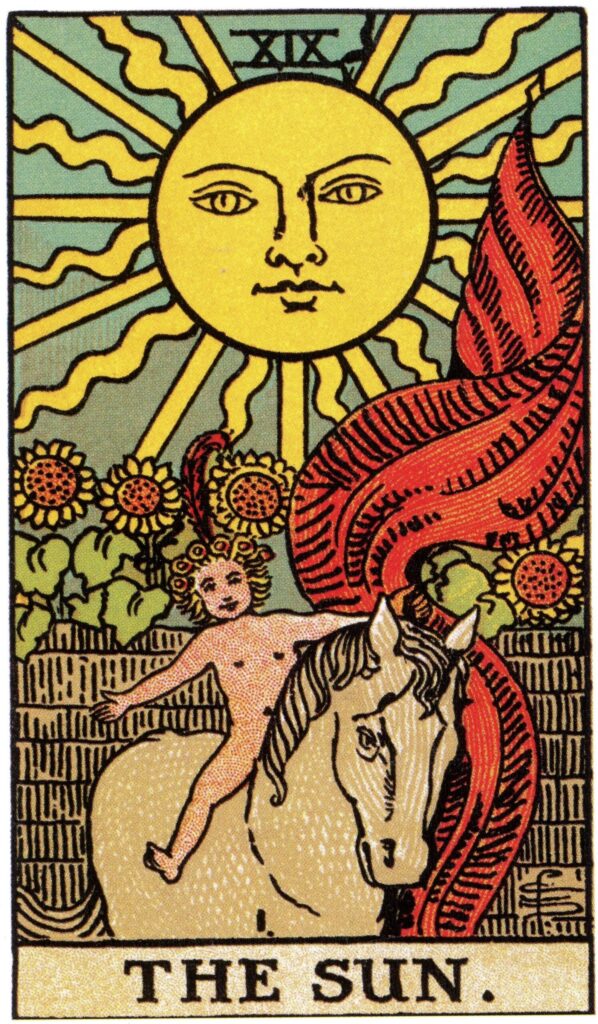
The solar path in the Tree of Life corresponds to the letter ר (Resh), the twentieth in the Hebrew alphabet, whose name literally means “head”. Resh (רֵישׁ) is the archetype of awakened intelligence, the gaze directed toward the source of Light. It is the instant when human thought reverses upon itself and rediscovers its Divine origin, becoming illuminated awareness. The Moon, which precedes it, is the path of ק (Qoph), the twenty-ninth letter, whose name means “nape” or “back of the head”. Qoph (קוֹף) governs the unconscious, the realm of reflections, dreams, and the images that inhabit the deep waters of the soul. Resh and Qoph form the two poles of consciousness: the face and the reverse, the Sun and its mirror, the dawn and the interior night. Between them unfolds the soul’s pilgrimage, the passage from shadow to vision, and from lunar dispersion to solar lucidity.
The alchemical Work manifests this same union of opposites. The Alchemical Marriage is accomplished between the conscious, reintegrating forces of the Sun, and the unconscious, dissolving forces of the Moon. The Great Work demands that Light and Darkness be joined in a single point, that gold and silver recognise their shared nature in a vertex. The tie between them is found symbolically in Ecclesiastes 12:6: “Before the silver cord is loosed, or the golden bowl is broken, or the pitcher is shattered at the fountain.” Silver, the lunar metal, seeks its inward polishing so that it may reflect the solar gold of the Spirit. The soul becomes a luminous mirror, reconciling consciousness and unconsciousness, Sun and Moon, Resh (ר) and Qoph (ק), until both coincide within the same circle of light.
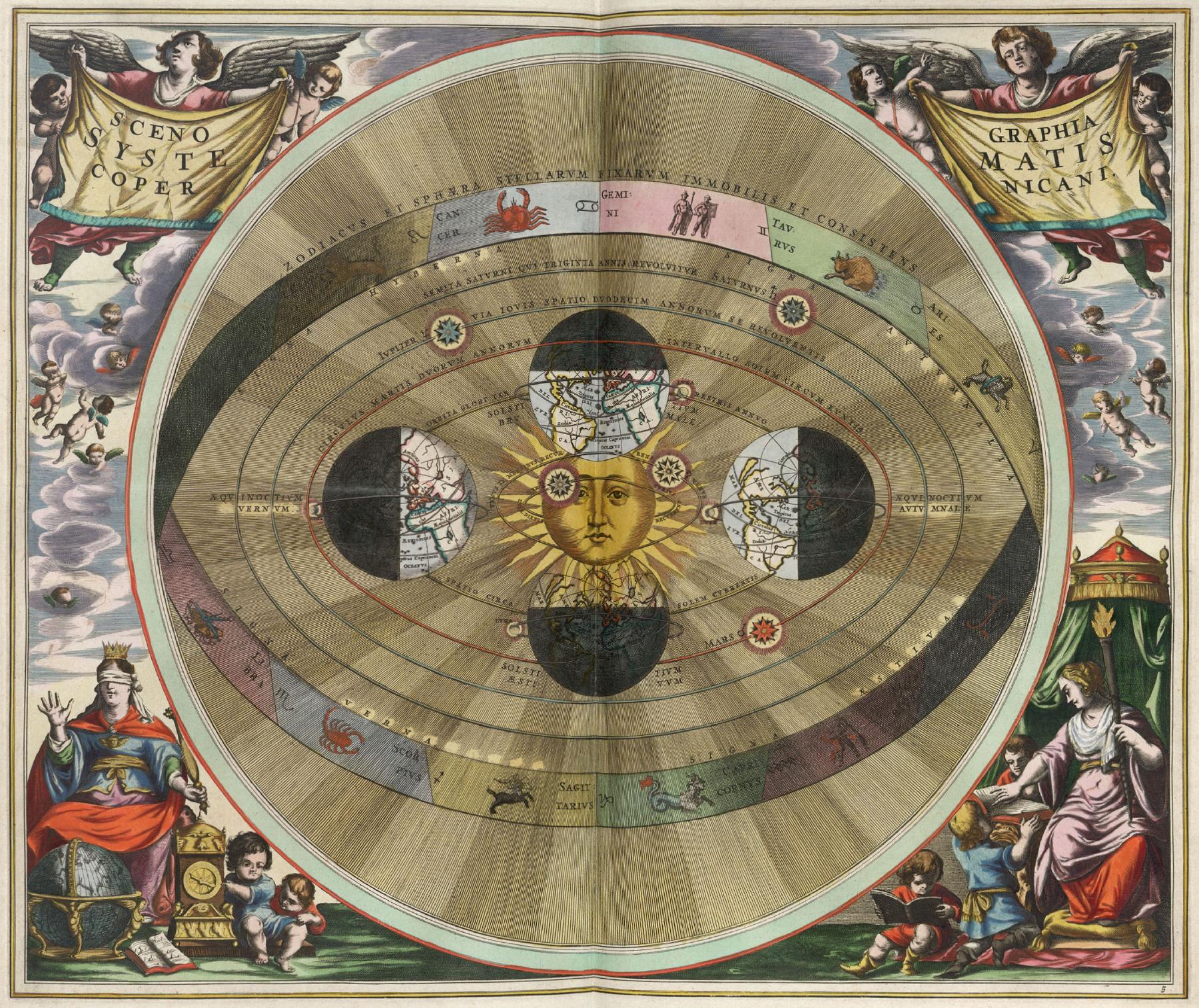
The same mystery can be found in the Metonic cycle, in which the Sun and the Moon, seemingly irreconcilable in their motions, find their point of harmony. Discovered by the Chaldeans and formalised by Meton of Athens in the fifth century BCE, the cycle reveals that, after nineteen solar years, corresponding to 235 lunar synodic months, the two luminaries return almost exactly to the same position in the zodiac. This coincidence reconciles solar time (linear, extroverted, awake) with lunar time (cyclical, introverted, mnemonic). Each of the 235 months is a twist in this cord of time, a turn binding day and night, which recomposes itself fully only after nineteen years, the same number of Tau and of Arcana XIX. The Metonic cycle is the celestial mirror of reconciliation between Spirit and soul, eternity and duration.
In Hebrew, the word נִקְפָּה (nikpáh) expresses simultaneously the ideas of cycle, revolution, and cord. Derived from the root קפף (kafaf), meaning “to bend”, “to fold”, or “to coil”, it describes a movement turning back upon itself, like a thread twisting and intertwining. The etymology is luminous: time is not a straight line but a living cord bending between heaven and earth, uniting the two luminaries in a single bond.
Nikpáh bears the gematrical value of 235, precisely the number of lunar months in the Metonic cycle, revealing that each lunation is a knot in this sacred cord. Reduced by Pythagorean arithmetic (2 + 3 + 5 = 10; 1 + 0 = 1), the number returns to the One, to the origin. Likewise, nineteen, reduced in the same manner (1 + 9 = 10 = 1 + 0 = 1), leads to the same unity. Both the solar 19 and the lunar 235 express the same truth: time itself is the thread that binds opposites, the silver cord linking Sun and Moon, Resh (ר) and Qoph (ק), until both dissolve into the breath of the One (אֶחָד).
Kύριε ελέησον