
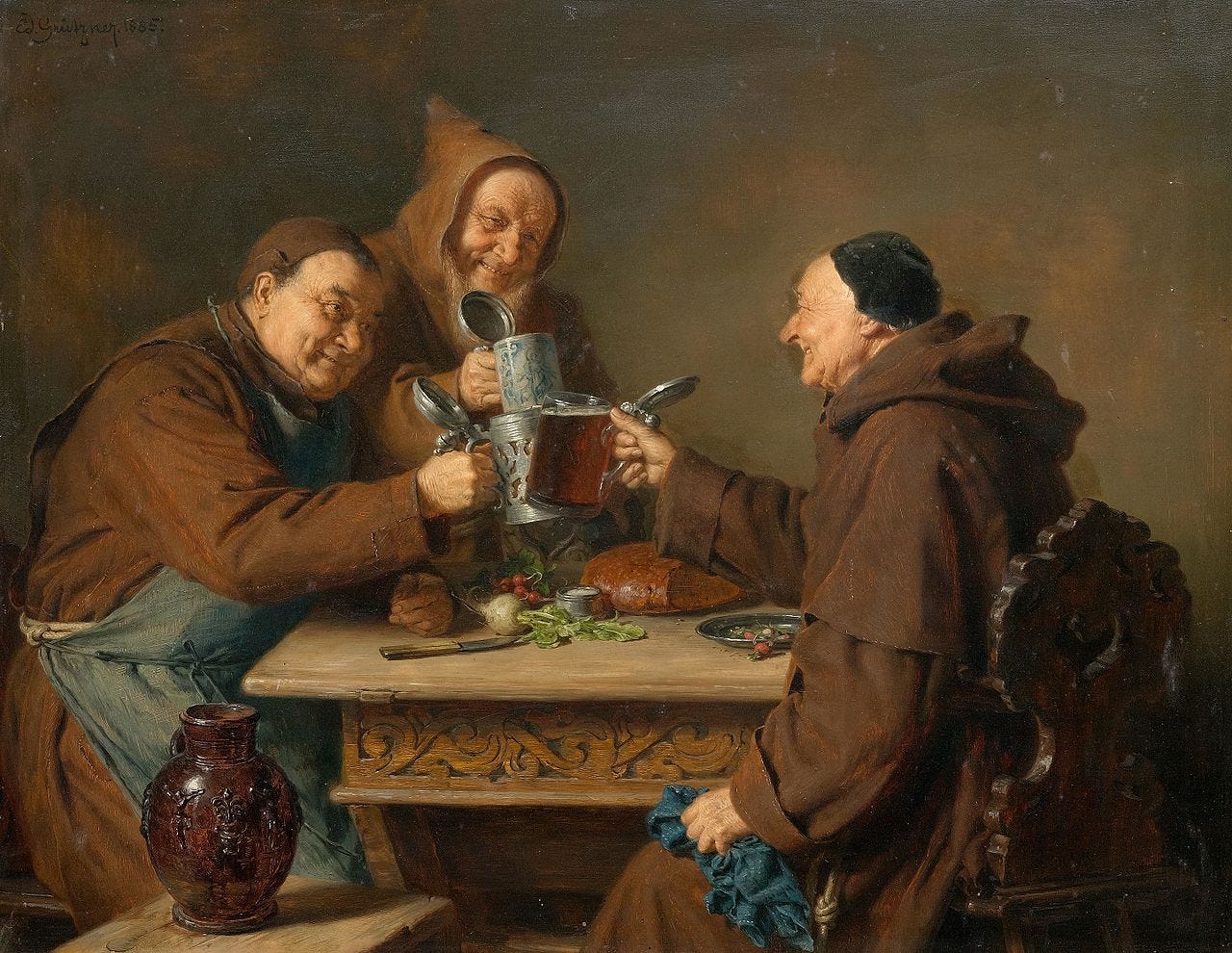
I visited the Kulminator in Antwerp on a cold afternoon around 2017 or 2018. The place was discreet, with the modest charm of a tavern that time had forgotten. At the entrance, the owner, an elderly man with a severe face and eyes that missed nothing, stopped us before we could step inside. “To drink or to taste?”, he asked, twice, as if probing our intent. The question aimed at our centre. To drink meant consumption and abandon; to taste implied presence and care. It was a simple question, but it carried the gravity of a rite. In that moment, I saw that the man was not just serving beer, but was guarding a passage, keeping intact the distinction between profane indulgence and sacred devotion.
The contrast between drinking and tasting shaped the entire atmosphere of the Kulminator. The space itself seemed to echo the quiet of the Trappist abbeys from which many of its bottles came. Those monasteries, enclosed by walls but open to the heaven above, treat labour as an extension of prayer. Brewing beer there is a daily discipline where patience and precision take on the nature of contemplation. Each cask is a vessel of obedience to time. The monks’ silence becomes the yeast that transforms work into offering, and the beer, when finished, carries within it the stillness of the cloister.
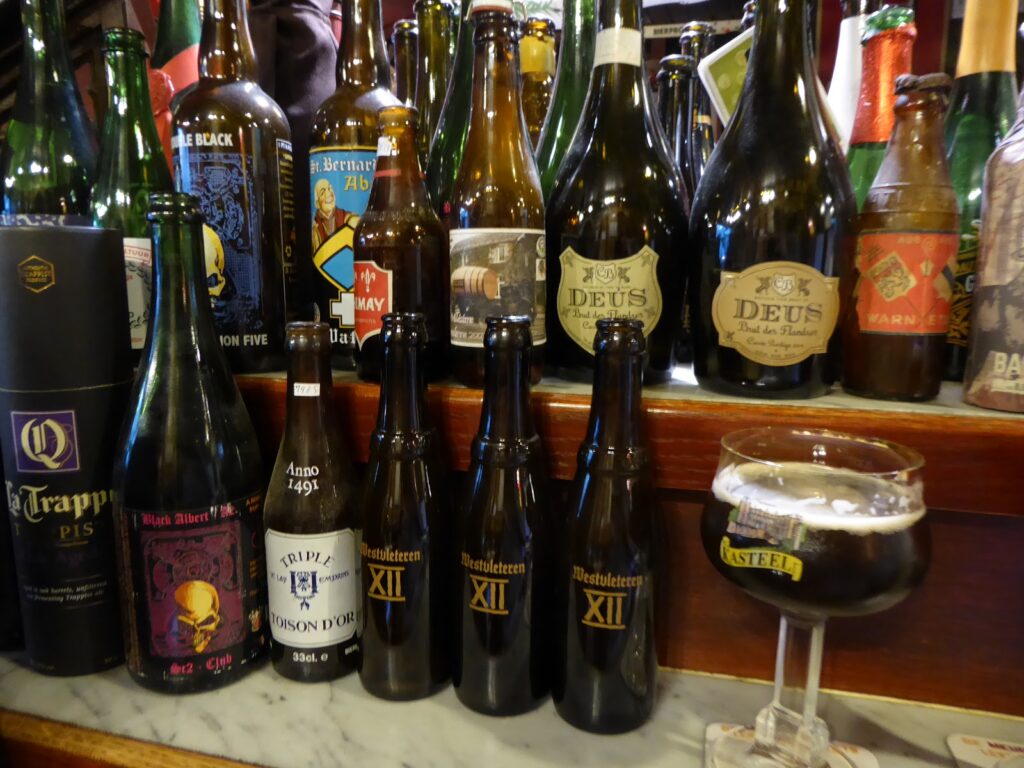
The Trappists follow the Rule of Saint Benedict, who understood that the spirit does not flourish by rejecting matter but by refining it. In his Rule he allowed a modest measure of wine each day – a hemina -, so that moderation itself could become a form of prayer. The word hemina, from the Greek ἡμίνᾱ, meaning “half,” denoted half a sextarius in Roman measure, roughly a quarter of a litre. Its etymology carries a quiet symbolism: the “half” as the precise middle between lack and excess, the point where discernment replaces indulgence. Wine, the symbol of the blood of Christ, in this case stands at the centre of this theology of balance, uniting body and Spirit. The monk who brews or the guest who drinks continues the same movement, transubstantiating the ordinary into something transparent to the Divine. Every sip, rightly taken, recalls that mystery behind the transformation of the carnal into the luminous.
At the Kulminator, that ancient understanding found its secular echo. The old owner, without robe or tonsure, carried the same vigilance as a monk at his cask. His question “to drink or to taste?” was an invitation to inhabit the act of drinking itself. But that lesson extends to everything that passes through the senses. To taste is to live under a quiet rule of attention. It is the discipline of remaining conscious in every act, however ordinary, whether opening a rare Westvleteren XII or a banal lager, pouring a glass of water, or taking a breath between tasks.
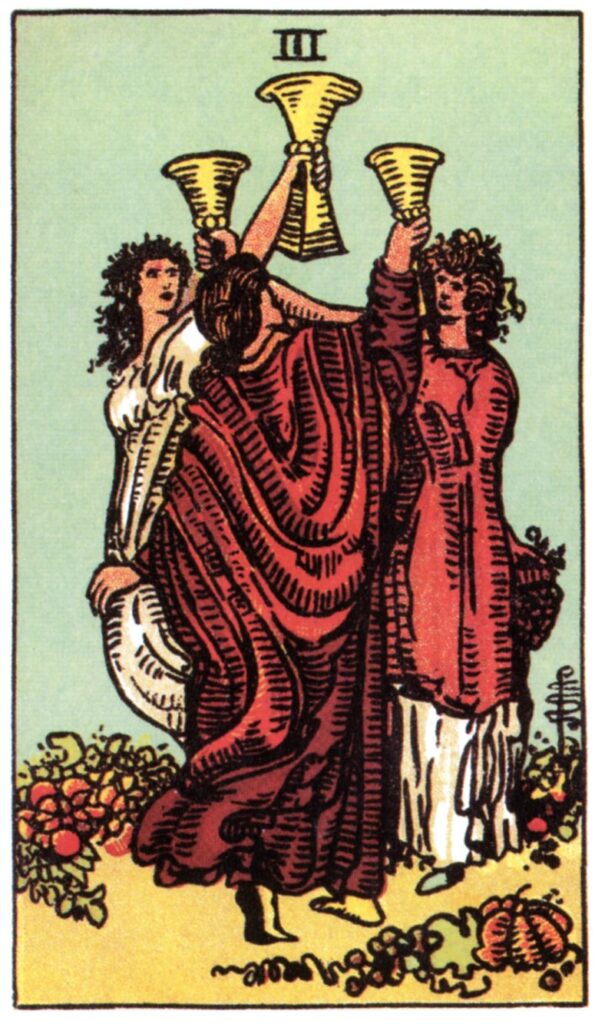
This same discernment is embodied in the Three of Cups in the Tarot. At first glance, the card seems to depict a simple festivity, with three women raising their chalices in celebration. But, when we trace it to its astrological decan, we find Mercury in Cancer, the principle of intelligence moving within the womb of Cardinal Water. It is the lucidity of the mind immersed in feeling, thought navigating emotion without dissolving in it. Kabbalistically, this corresponds to Binah, the sphere of Understanding: the matrix that gives form and boundary, the vessel that distinguishes between the Sacred and the profane. The Three of Cups teaches that true joy comes with the awareness of pleasure itself, the ability to perceive the Divine rhythm even in what seems purely human.
Each moment offers the same choice the old man posed at the door: to consume or to perceive. The border of perception and the door of the Kulminator survive only through vigilance, through nepsís, that subtle, interior stance that turns the most trivial gesture into a renewal of the covenant between matter and Spirit.
Kύριε ελέησον