My natal chart is born with a structural inversion that alters the entire logic of the zodiacal wheel. Where the common course begins in Aries in the First House, mine begins in Libra, and everything unfolds as a mirror. This inversion means that what normally culminates in Capricorn in the Tenth House – the point of the South, of the work, of the mission, of Archangel Michael – manifests in my case in Cancer. What in traditional charts represents the building of a Capricornian vocation, made of stone and structure, becomes a calling of water and reception. The Tenth House, diurnal by standard, assumes in me a lunar and nocturnal character. The work is to nurture, to receive, to care.
Cancer is Cardinal Water and the most maternal. The Moon, its ruler, is cold and moist, a nocturnal luminary, symbol of the soul that reflects rather than emits. It rules my highest point and is found peregrine but in sect, in Libra, precisely in the First House. The impulse of Yod, the principle of will and emanation, reaches me to be received in the element that represents the first He of the Tetragrammaton, related to emotional gestation.
But the mirror of the South is the North and it is there that the roots are found in any chart. The Fourth House, the Inferus, the Nadir associated with Archangel Gabriel and the subterranean point of the map, is Capricorn, the cold and Cardinal Earth governed by Saturn. The foundation is firm, demanding, and silent. Saturn, domiciled and in his own Egyptian bound, out of sect and unaspected, forms an isolated and self-sufficient force. His condition in a nocturnal chart renders him colder and more withdrawn, deepening his melancholic temperament. Out of sect, his nature turns from constructive discipline to austere endurance; what might otherwise build becomes instead a slow crystallisation of solitude.
He embodies the taciturn gravity of the night: heavy, contemplative, restrained. It is an energy that grants solidity but also imposes limit, and its lack of dialogue with other planets imposes a cold foundation, that compels Cancer in the tenth to mature, to give form and restraint to emotion.
Now, the presence of Chiron in my chart occupies a position I cannot ignore. As a traditional astrologer, I tend not to highlight modern symbols that much. But the precision of Chiron’s placement compels attention. Also situated in Cancer, its angular position implies a visible wound, the point where personal vulnerability meets public responsibility. In the sign of the Great Mother, it evokes the emotional cost of vocation, the ache of having to sustain others while tending to my own frailty.
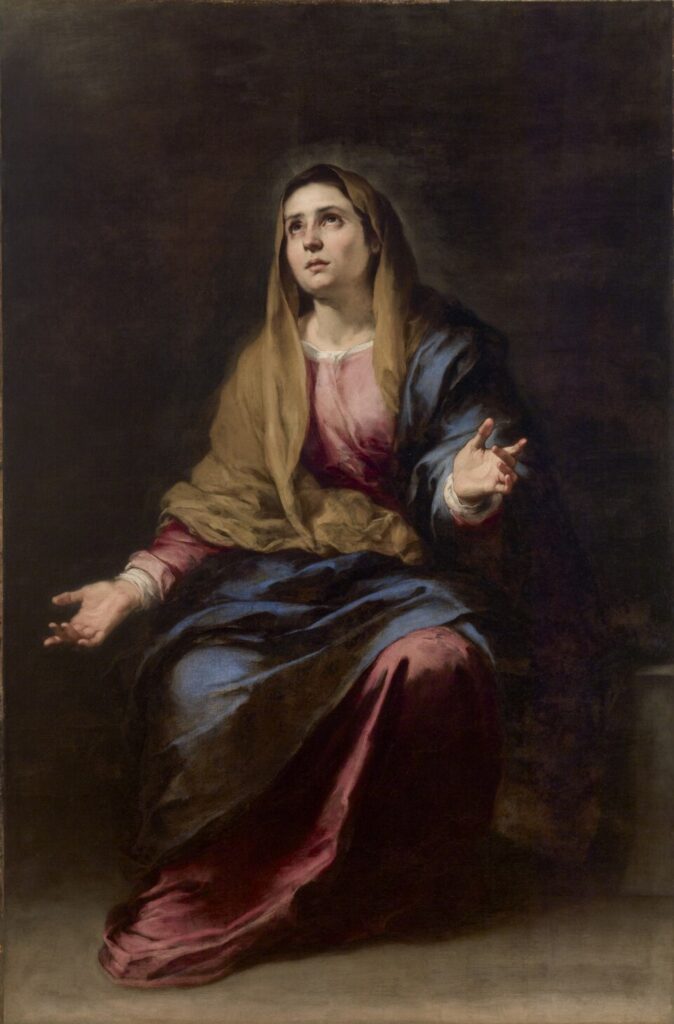
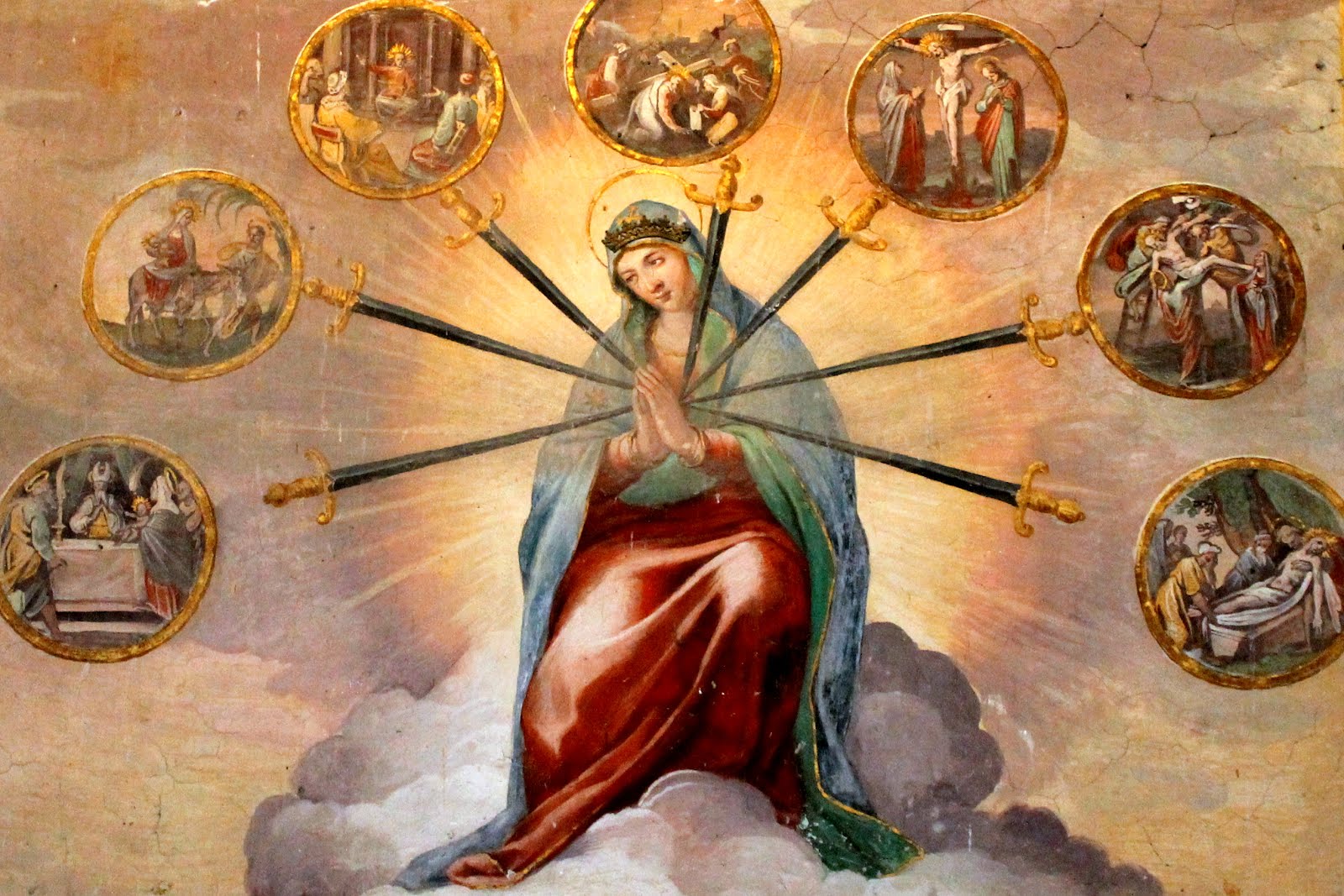
Not only that, but I have an axial opposition between Saturn in the Fourth House and Chiron in the Tenth. This vertical line that joins the Inferus to the zenith is a true axis of symbolic crucifixion: the soul suspended between the burden of matter and the demand of spirit, compelled to sustain suffering without denial. The archetype of the Mater Dolorosa finds here its perfect correspondence. It arose at the heart of the Christian tradition as the image of the Virgin at the foot of the Cross, and traces back to medieval meditations on the Seven Sorrows of Mary, the Our Lady of Sorrows, established by the Church as a model of redemptive compassion.
Those Seven Sorrows (the prophecy of Simeon, the flight into Egypt, the loss of the Child in the temple, the encounter on the way to Calvary, the crucifixion, the deposition, and the sepulchre) also correspond symbolically to the influence of the seven classical planets upon incarnation. Each impress a distinct form of pain, a particular trial, and Mary, by enduring them all, becomes the synthesis of the soul that suffers consciously. The heaviest of these planetary sorrows is precisely Saturn, as he bears the weight of time and space, the constriction of matter that imprisons Spirit within form. His pain is the densest, the most enduring, and the least visible: the sorrow of the world’s gravity itself.
In geomancy, Saturn in Capricorn is aptly named Carcer, the Prison, a figure that embodies this same tension. In it, Fire (Will and Emanation) in the first line and Earth (the Physical World) in the last are active, but both are trapped between passive Water (Creation and Emotion) and passive Air (Reason and Formation). The result is a sealed architecture: potential bound within necessity and vitality limited by order. It is the image of incarnation under weight, the Spirit enclosed in the cell of form.
My opposition between Saturn and Chiron mirrors that same spiritual tie. Saturn is the hardening of the roots and Chiron the opening wound in a placement of visibility. Much Like Mary standing at the foot of the Cross, my chart describes a vocation demanding sacrifice, a compassion that must become form. The Mater Dolorosa mediates between love and limit, the image of mature sorrow turning slowly into wisdom – or so I hope.
Kύριε ελέησον