A few years ago, when I first began to handle the Tarot, I did so with the lightness typical of a beginner, with that blend of scepticism and playfulness which protects the spirit when it comes close to the invisible. There was no fear, no heaviness, only curiosity and fascination with the forms. I used the Tarot of the Divine deck, airy and youthful, where each Arcana, major or minor, told a small myth drawn from the most varied cosmologies. It was as though each card were a scattered fragment of a prisca theologia, an ancient wisdom retold in a playful tone, without weight or dogma attached to it.
Among the many readings I did in those early days, one remains particularly vivid. I drew cards about a dog named Scuba. He was not mine, but I loved him dearly. He belonged to a friend, and I often took him for walks. He had that rare sensitivity of animals who seem to read the human soul, to perceive silence silently. At the time of the reading, Scuba had already died. My friend had chosen to have him cremated and to keep his ashes in a small box he had brought back from a journey to Cairo, in Egypt.
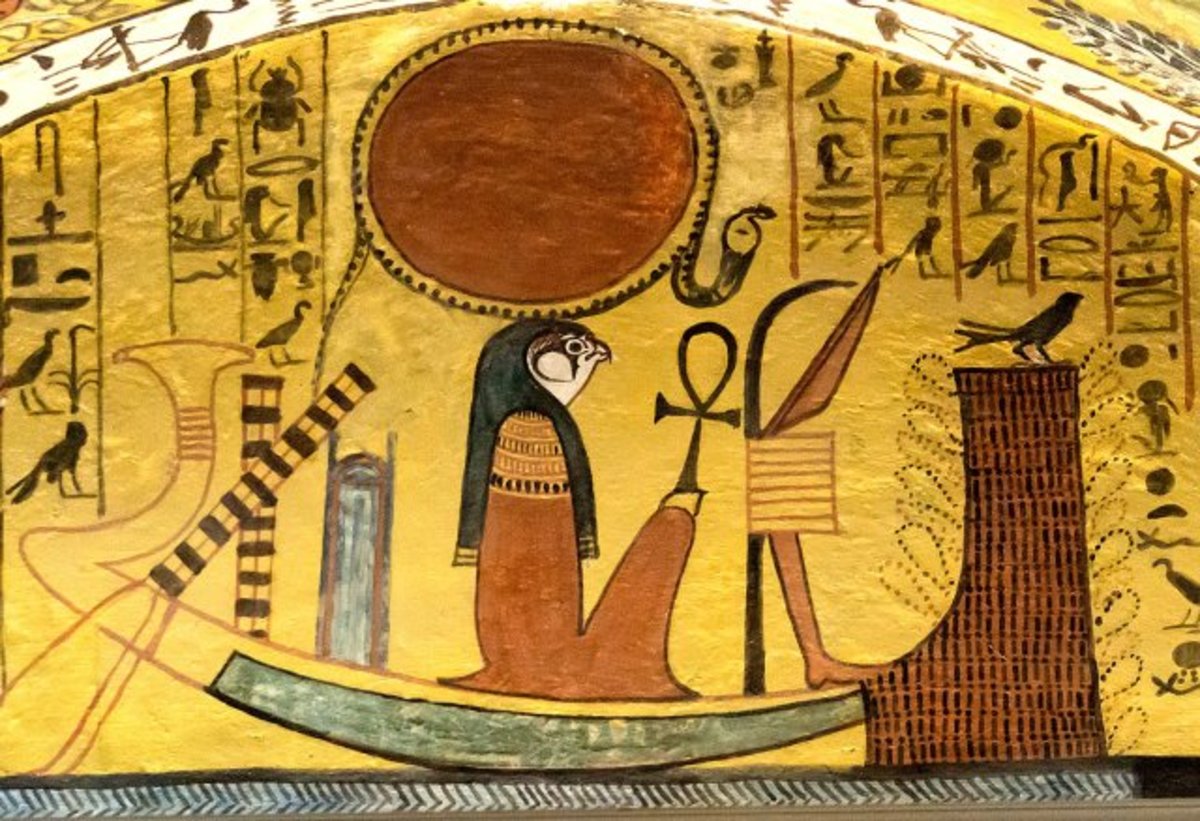
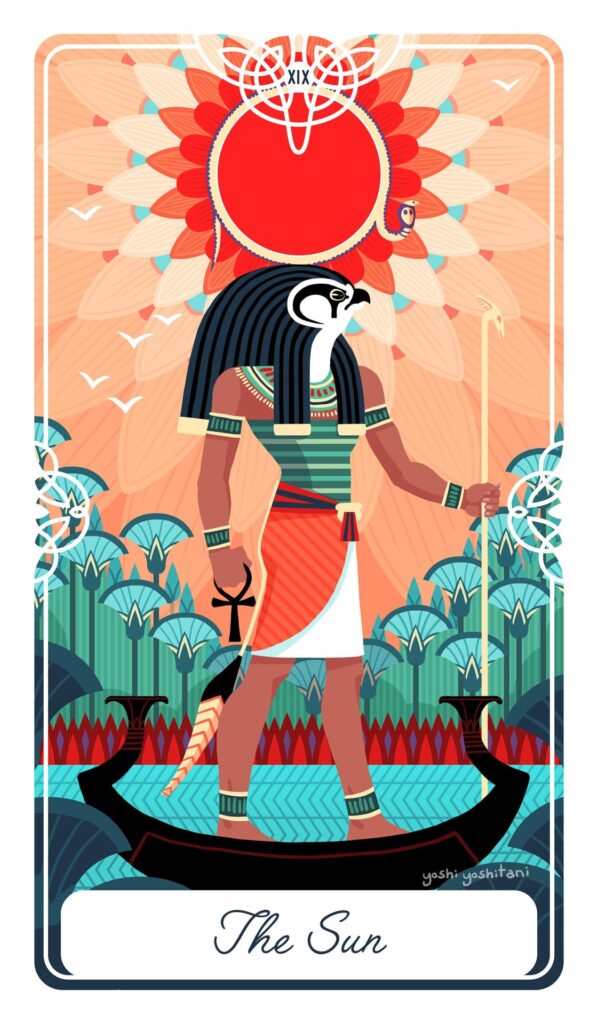
The first card to appear was the Eight of Wands. I laughed. It was obvious: his haste, the pull of the leash, the delirium of running across patches of grass, against stray dogs and those tethered to their owners. The mutable fire of Sagittarius seemed mirrored in his paws, which touched the ground like flaming arrows. Then I asked the Tarot where he could be now. Out came the Sun. Arcana XIX. And, in that deck, the Sun was Ra, the falcon-headed god standing upon the solar barque. Above him coiled the Uraeus, the living serpent of fire that crowns and guards the solar light, forever watchful against the darkness. The image struck me right away: the Egyptian box where his ashes rested, the luminous voyage of the soul across the waters of eternity. It was as though Scuba had joined that radiant journey, carried by Ra, returning to the Sun itself, the eternal Orient.
It was at that moment I first understood the power of the Tarot. I realised that these cards were not mere symbolic images, but living mirrors of a universal language. I can now recall Papus and his words on the seventy-eight cards containing the symbolic gears of the Cosmos. Each reading is a small act of creation, a reflection of the movement of the spheres, a microcosm answering to the macrocosm. The Tarot is meant to reveal and to see is already to touch the mystery.
Today, without any particular reason, I remembered that reading. And I decided to ask the Tarot where the lightness had gone, that ease with which I once handled the cards, unaware of the weight they carried. I sometimes miss it. The card that emerged was the Wheel of Fortune. Arcana X. Destiny in the hands of Jupiter, the planet that shapes circumstances and governs the rhythm of ascent and fall with his kaph. The Wheel that rises and descend, showing that all rests in the hands of the Architect.
In the Rider–Waite deck, the Wheel also bears Egyptian traces: the sphinx atop it guards the axis of order, while the serpent of Typhon descends and Hermanubis ascends, representing fall and restoration in one motion The lightness I had has fulfilled its purpose, bringing me to this point in the path, where my gaze is heavier but more lucid. Perhaps it will return one day, in another form, when the Wheel turns again and reminds me that the Divine game never ceases to spin, as it merely changes its centre.