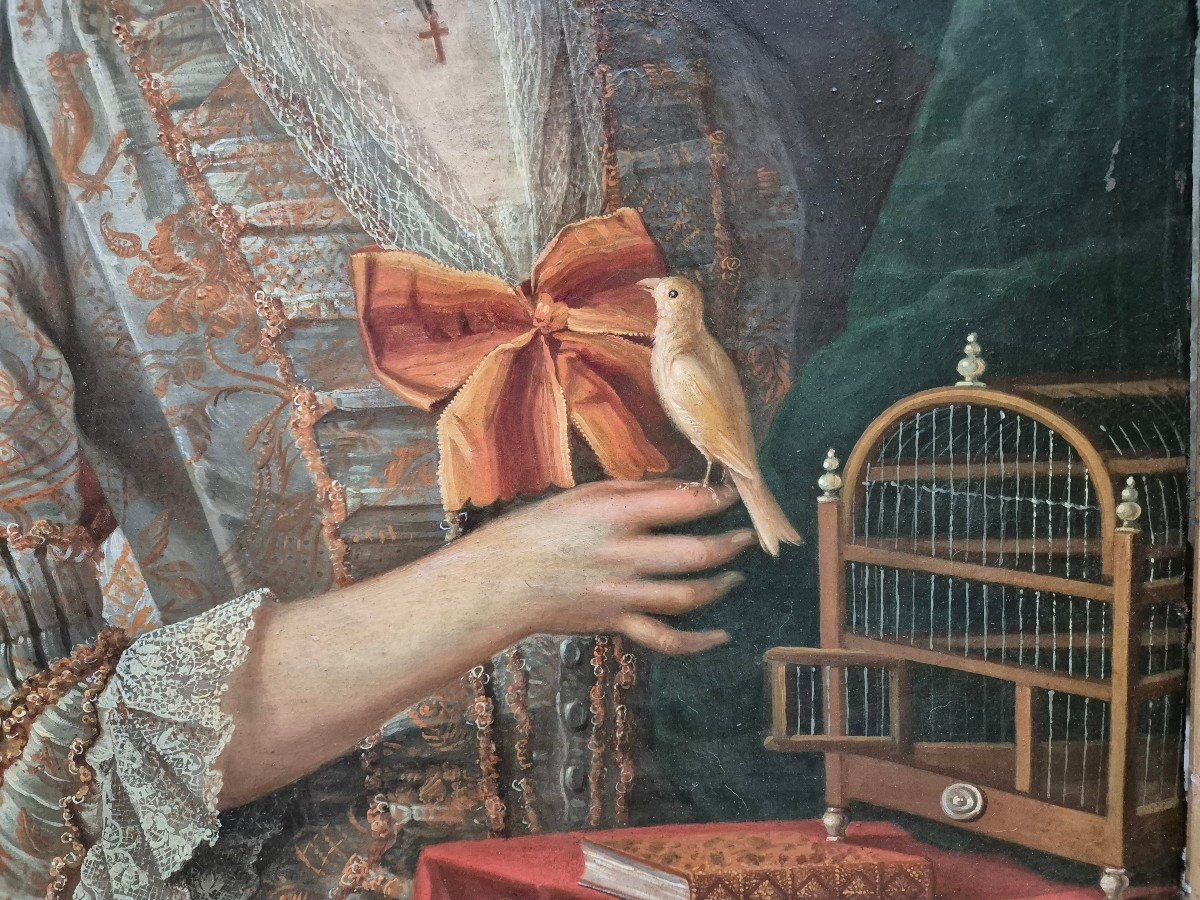
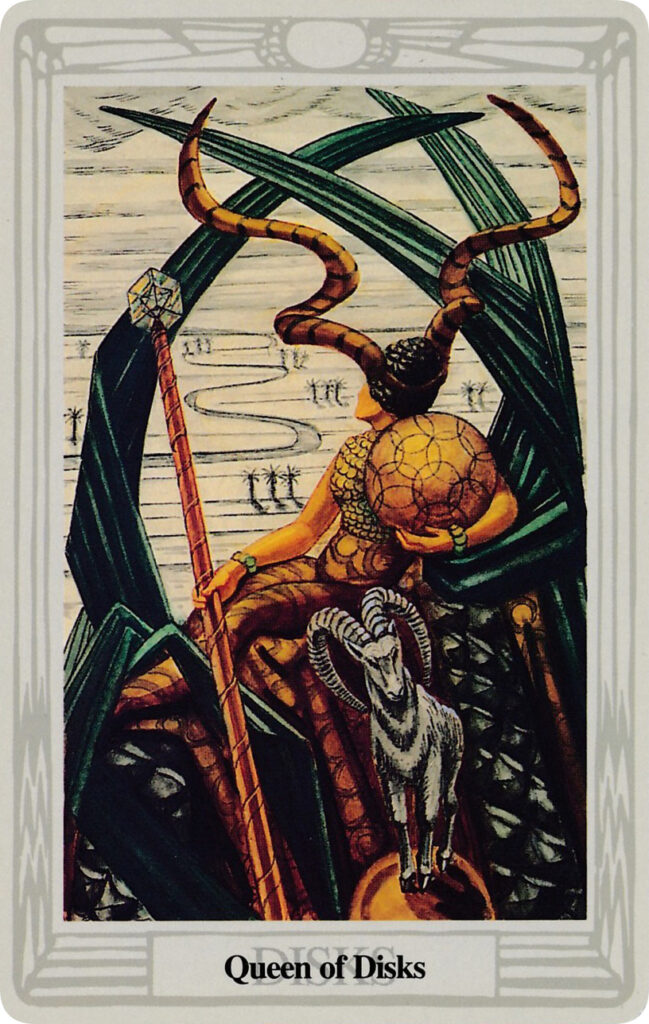
Yesterday, while listening to the beautiful Medusa by Brendan Perry, I felt the impulse to draw a Tarot card. The card was the Queen of Pentacles. The image that immediately arose was that of a tear falling onto the earth, slow, dense, laden with memory. Perry’s voice seemed already to contain that gesture, especially when he sings “In your bedroom you keep an iron cage / Where a blackbird sings her freedom song / For you know the true value of keeping slaves / They sing the saddest of songs.” There is a grave, nostalgic beauty there. Something knows it is imprisoned and, even so, insists on singing.
The Queen of Pentacles is emotion on the plane of incarnation. Water mixed with earth. Feeling immersed in the density of the body, of time and matter. She speaks of tangible fertility, of what grows in the sensible world, but it also carries a subtle melancholy, the diffuse memory of another state, nebulous and mystical in the etymological sense of the term, that which remains wrapped in mystery. The tear that falls onto the earth seeps in, mingles with the dust, becomes humus: the Latin word for soil, ground, earth in its most basic and fertile sense. From this same root come humanus, the human being as “the one of the earth”, and humilitas, humility, the condition of being close to the ground, to what is low, dense and material.
The Spirit manifests when it assumes form, through a patient, heavy, transformative delay. We are also precisely within her dominion now, as she spans from the last decan of Sagittarius to the last of Capricorn, and we stand now at the moment when the Sun has already entered cardinal Earth, where growth begins slowly, under weight, measure and time.
The drama of incarnation reveals itself when we observe the functioning of the cosmos as order. Fire, air, water and earth structure the human experience. Fire says “I want.” Water says “I feel.” Air says “I think.” Earth says “I am.” These four verbs compose the Law of the world, the domain of the Demiurge, the cosmic craftsman who executes a plan through repetition, proportion and form. From his operation arises everything that lives, grows, transforms and wears away. Wear itself belongs to the logic of the mechanism.
The human being participates fully in these four verbs, but carries an additional gesture, that is strange and unconfortable. It arises when we say “I know.” This knowing places us in an intermediate position, suspended between planes. We inhabit the horizontal axis of the sensible world, of the body, of time and of matter, and simultaneously we sense a vertical axis that traverses everything, connecting the visible to the invisible, the sensible to the intelligible. We are the hook between worlds, a half-open door, a tense bridge between what manifests and what only allows itself to be intuited. This is the most ungrateful and most decisive position: to be within the cosmos, subject to the Law, and at the same time conscious of its structure. It is here that gnosis occurs, when the Spirit introduces itself into the interior of form. The blackbird sings inside the cage because the song is born precisely from this friction, this recognition of the prison, this incarnated knowing that remembers another place while remaining here.
And it is with the very instruments of the world that this knowing attempts to express itself. Language, symbol, number, Tarot, music, poetry. Each of these instruments belongs to the order of the cosmos, yet serves as a support for the song. None exhausts the mystery, but all allow it to vibrate. The Queen of Pentacles sustains this tension with silent maturity. She keeps emotion within the body of the world, accepts the weight of the earth and keeps alive the memory of another plane. There is always something in the human being that impels them to continue, to use what is imperfect in order to reach the other side, to fixate what is merely volatile.
Just as I do here, with this text. Merry Christmas.
Kύριε ελέησον