
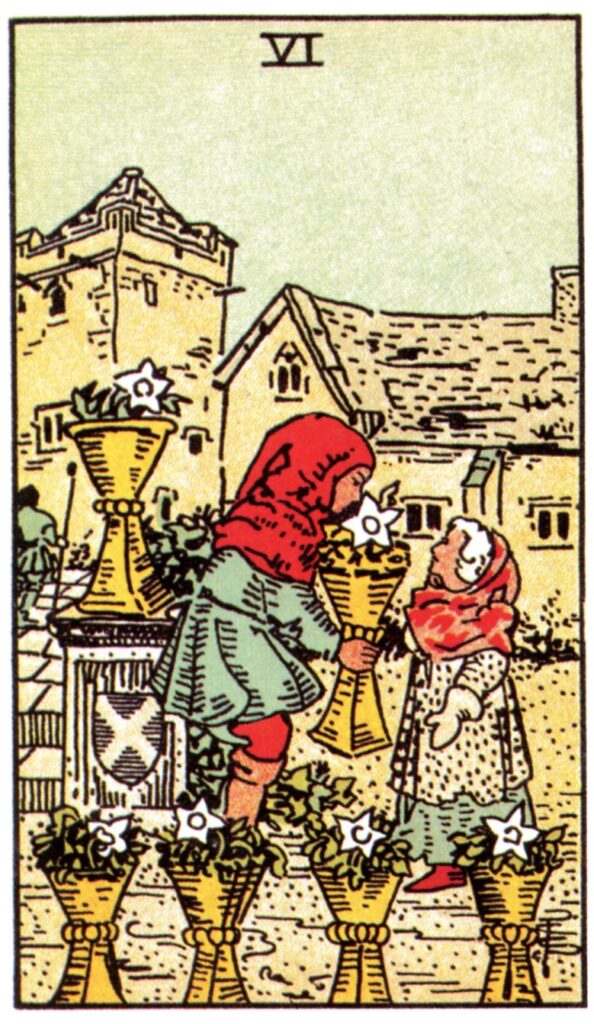
The most common reading of the Six of Cups associates the card with nostalgia. That interpretation almost always comes from the usual iconography. Children, flowers, simple gestures, “innocent” scenes. Let’s see what nostalgia actually means. Nostalgia comes from the Greek nóstos (return) and álgos (pain). Literally: the pain of an impossible return. The impossibility of going back. The term was coined in the seventeenth century by Swiss doctor Johannes Hofer to describe a pathology observed in soldiers and emigrants who could not go back home. But the Six of Cups is not exactly that.
When we look at the Six of Cups through its astrological attribution, the card is the decan of the Sun in Scorpio. The Sun is the star of consciousness, vitality, gratification, and identity. The very word energy comes from the Greek enérgeia, which means “being in act”, “force in operation”, “potency in manifestation”. The Sun vivifies. Scorpio is a fixed sign of Water, ruled by Mars. It is centripetal. It works through retention, control, fixation, and intensification of sensations. Water is the element of the sensitive, the impressionable, the emotional. In Scorpio, emotion is retained, concentrated, controlled, and very often possessed.
This then creates a very clear image. The Six of Cups is the Sun (gratification and consciousness) in a sign that wants to keep what gives it pleasure, security, or emotional stability. It does not want to let go. There is also a duplication of the solar principle here. The decan is of the Sun in Scorpio, and the number Six itself corresponds to Tifereth, the solar centre of the Tree of Life, the principle of balance, harmony, and beautiful form. So we have Water, emotion and sensibility, vivified by the Sun, organised into a stable form, retained by a fixed sign such as Scorpio.
This card can only be fully understood when seen in sequence with the Five of Cups. The Five of Cups is Mars in Scorpio. It is emotional loss, rupture, mourning, destruction on the plane of Water. Mars is in domicile in Scorpio, and therefore has maximum capacity for action there. And that action is surgical, violent, and irreversible on the affective plane. In geomancy, Mars in Scorpio corresponds to Rubeus, the figure considered the most noxious, lethal and dangerous.
The Six of Cups arises after that devastation. It comes after loss, after mourning, after the wound. The Five is always disruption of Geburah. The Six is always recomposition in Tifereth. Here this translates very simply. The emotional sea has been rebalanced. The psyche finds a stable form again. And, more than that, it wants to conserve that state. It wants to preserve it. It wants to stay there because that is what Scorpio does.
This is where the image of the child makes sense, but not in a sentimental sense. It is not childhood as an idealised past. It is the child as a gesture of attachment. The child who does not want to let go of the toy. The child who clings to what gives them security and stability. In the Six of Cups, consciousness wants to remain in an emotional state that no longer hurts after going through hell and back in the Five of Cups. It wants to keep the form found after the catastrophe.
But the very structure of the cycle shows the problem. After the Six comes the Seven. And the Seven of Cups is Venus in Scorpio. Multiplication, illusion, emotional venom. Unfortunately for Scorpio, nothing in the world stays the same forever. Change is the only constant.
Kύριε ελέησον