

If he were still alive, Paul Auster today would be celebrating his 79th birthday. He was one of my favourite writers when I was a teenager, and I decided to take a look at his chart.
I. The Venusian Women of His Life
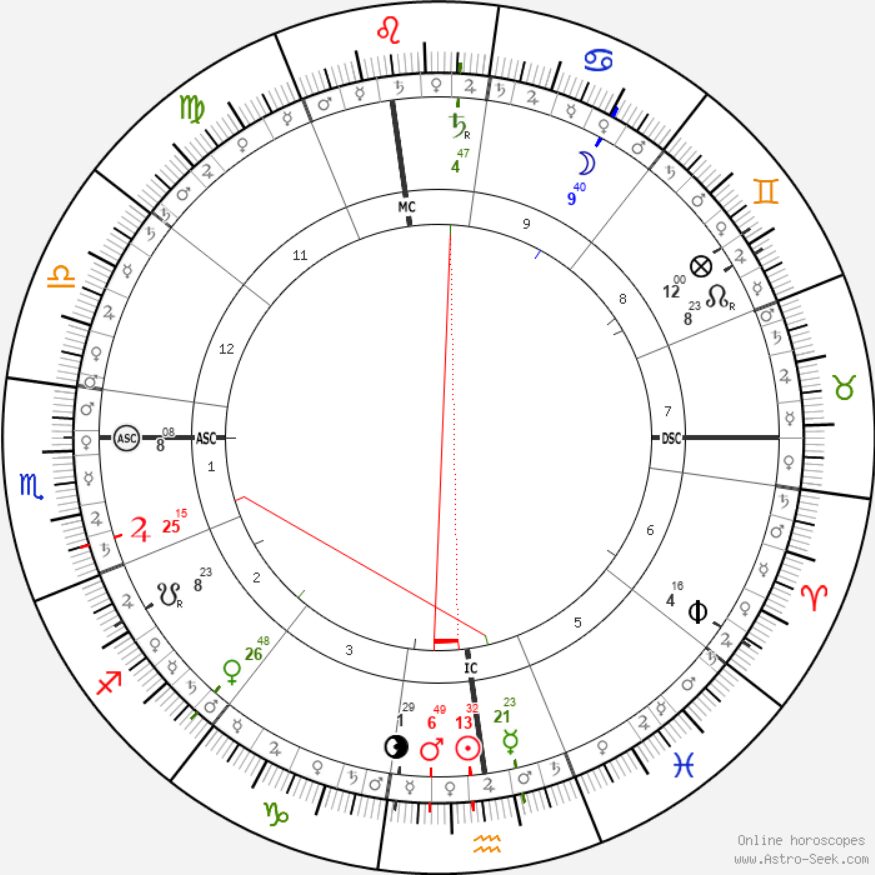
I right away spotted Venus in Sagittarius, in the 2nd house. This is not a particularly comfortable position, because Sagittarius is hot, dry, masculine and unstable, qualities that Venus does not especially enjoy. Venus prefers coldness, stability, sensual pleasure, continuity and softness. Even so, this Venus describes Auster’s reality well. Because Venus rules the 7th house in Taurus, it signifies his women, his love relationships. There is no planet better suited to rule the 7th than Venus, especially with Taurus on the cusp, which gives relationships a beautiful, tactile, carnal, slow and deeply sensual tone.
With Venus in Sagittarius, the women in Auster’s life would almost always have an aesthetic, intellectual, philosophical or foreign flavour. They would be connected to words, dialogue, writing and thought. This fits his biography clearly. His long partnership with Siri Hustvedt, herself a writer and intellectual, was also a sustained mental and philosophical dialogue. It was a shared world of ideas and language, very Sagittarian in nature. Venus in the 2nd house also means that these women played an important financial role in his life. Auster went through long periods of financial struggles, especially before literary recognition arrived, and the economic and structural support of partners was crucial at several points.
There is another important point. Venus also rules the 12th house, associated with isolation, sabotage, and hidden enemies. This suggests that the same women who supported, inspired and helped Auster were also tied to processes of erosion, psychological exhaustion and symbolic imprisonment, or were themselves women who went through periods of seclusion or prolonged illness. The biographical detail fits also in the case of Siri Hustvedt, who throughout her life dealt with episodes of physical and psychological suffering, neurological crises and long clinical processes, themes that she herself explored explicitly in her writing.
The 12th house in Libra also points to conflicts on the mental and relational level, to silent tensions, unspoken resentments and rational wear. At certain moments, the feminine appears also as a place of loss, dissolution and invisible suffering. This fits well with the melancholic and fatalistic tone that runs through much of his work, where love and loss almost always walk side by side.
II. A Jupiterian Identity Related to Love and Creativity
When I look at the ruler of Sagittarius, I find Jupiter in the 1st house, in Scorpio, on the Ascendant. This is strong. The women signified by Venus touched Auster directly at the level of identity, body and presence. Jupiter in the 1st amplifies everything it represents the identity of the native. In Scorpio it does so intensely, obsessively, and with great emotional demand. This means dynamics of fusion, jealousy, control and major crises. Scorpio is fixed and martial, and Jupiter enlarges these qualities. Relationships were transformative, consuming, and sometimes painful.
This same Jupiter also rules the 5th house in Pisces, the house of creativity, pleasure. Creating was part of Auster’s identity. The direct link between the 1st and the 5th houses through Jupiter shows a total union between identity and the creative act. His literary work is autobiographical, even when it is not so factually. The self is always at stake, even when hidden behind chance, characters or layered narratives. However, his career, signified by the 10th house, was a constant tribulation.
III. A Difficult Career Imposed by Saturn
We just need to look at the condition of that house. This retrograde Saturn in the 10th is harmful. The planet of limits, constriction and death is in detriment in Leo, a sign it hates for its vitality and force. In this case, Saturn expresses its worst qualities, made heavier by its position in the 10th, the second strongest house. This speaks of delays, blockages, late recognition, people that kept blocking his professional breakthrough, and a constant sense of burden in his life as an author. Auster took decades to stabilise his career and endured rejection, precariousness and uncertainty, all of which fits this Saturn perfectly.
The rulership of the 10th house was also difficult. Leo is ruled by the Sun, and the Sun is in Aquarius in the 4th house, also angular, but equally debilitated. The Sun naturally seeks the highest houses of the chart to shine brightly, but here it is buried at the bottom, at the Imum Coeli. There was a permanent clash between what sustained him inwardly in the 4th and what appeared outwardly in the 10th, creating a draining Sun-Saturn opposition. The Aquarian stellium in the 4th, with a debilitated Sun combusting Mercury and Mars (the planet ruling his Ascendant), speaks of a complex and heavy family structure, marked by confused, absent or problematic solar, martial and mercurial figures. This shaped his writing and his way of being in the world. His recurring themes of absent fathers, fractured identities and homes that fail to protect are written clearly into this configuration.
IV. The Balm of a Domiciled Moon As His Sect Light
Because he was born at night, Auster’s sect light was the Moon nonetheless. And what a Moon. Domiciled in Cancer, strong, whole and sensitive, and placed in the 9th house, the house of philosophy, the search for meaning and God. This says a great deal about his tender, fluid and deeply receptive emotional patterns. Even when he writes about chance or the violence of fate, there is always a lunar layer of compassion, human fragility and attentive listening to suffering in the others.
There is also a beautiful paradox here. The Moon occupies the 9th house, the best of the cadent houses and the joy of the Sun. In other words, the place where the Sun likes to operate, illuminate and give meaning is here occupied by his counterpart, the Moon. In Auster’s life, the Moon behaved as the true Sun. A true nocturnal Sun. His light was one of indirect, reflective and intimate illumination. Through sensitivity, memory and pain transformed into language, he found his vital centre. Faced with difficult and heavy masculine planets in his chart, Paul Auster found comfort, balance and meaning in the feminine principles signified by Venus and the Moon.
Kύριε ελέησον