

Today I was watching a video recorded by the astrologer Robert Corre in 1979, from the period when he, like many other brilliant minds, was studying with Zoltan Mason in New York City. The lesson focuses on a weather a doctor would have the capacity to become an astrologer, to change career and relinquish her medical diploma. While watching it, I remembered Robert Zoller, another of Mason’s students who later became a teacher himself and who adopted several important concepts from Mason, including the notion of primary motivation associated with the degree of the native’s Ascendant.
I picked up the Tarot and decided to do a simple two-card reading. One card for Mason and another for Zoller. The intention was to interpret them through the symbols of the Minor Arcana. The first card, drawn for the German-American teacher, was the Queen of Pentacles. All queens belong to the receptive pole. They are figures who welcome, nourish, listen and respond to what approaches them. They are associated with the element of Water, the receptive and fertile principle that sustains what comes into contact with it.
The Queen of Pentacles translates this into the dense field of matter symbolised by the pentacle, the disk. She is the one who pours this nourishing water upon the soil, fertilising what lies before her. Applied to Mason, the image suggests a teacher who created within his classroom a space of receptivity and growth for his students. His position was not that of a king who imposes or decrees, but rather that of a queen who listens, observes, cares and adapts her teaching to what stands before her. Malleable. And, because it is a card of Earth, there is a practical, technical and grounded quality to it, symbolically related with the Saturnian sign of Capricorn attached to this court card. It points to someone cerebral, technically capable, and able to transmit that technique to those seated before him.
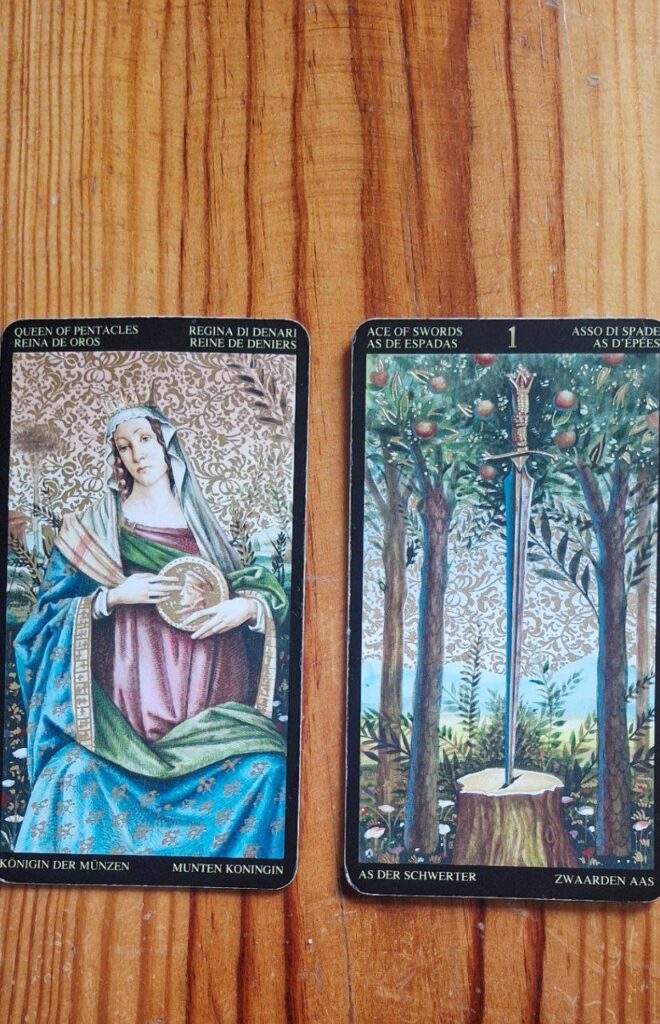
The card for Zoller was the Ace of Swords. The Ace always represents the seed of an element, the point of origin from which multiplicity unfolds. In the case of Swords we are dealing with the principle of thought, discernment and intellect that separates and distinguishes one thing from another. Zoller was this sword emerging from what the Queen had nourished. What Mason nurtured in the tradition became, in Zoller’s hands, a renewed technical model of astrology. Robert was known for his tireless effort to scour libraries in search of astrological and philosophical manuals written in Latin, many of them from medieval times. He did not confine himself to astrology as a mere technical discipline either. He sought to put it once again within the broader context of Neoplatonism, Aristotelianism, Hermeticism, Jewish mystical Kabbalah, medieval Christian scholasticism, and angelology, allowing astrology to re-emerge as a spiritual science, an art of judgement grounded in mystical, theological and teleological principles.
For Zoller it was inconceivable to approach astrology purely as a technique without that spiritual foundation which, as the term itself indicates, implies believing and knowing that there are spirits and working magically with them in order also to refine oneself as a divinatory and judicial instrument. Zoller brought that Sword of ancient discernment back into astrology, almost like someone who unearths Excalibur once more in order to separate the wheat from the chaff within a modernity that has psychologised and individualised everything, ignoring the cosmological symbols that ultimately point back to the One.
Kύριε ελέησον