

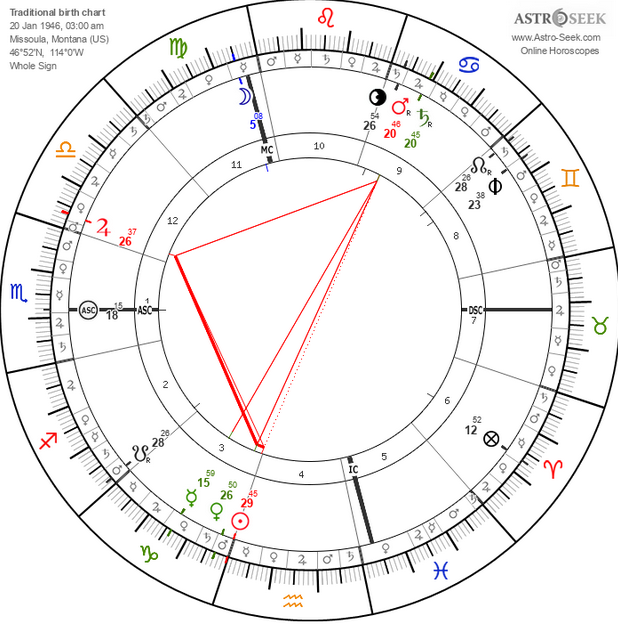
David Lynch would have turned eighty yesterday, and this text offers an introductory delineation of his natal chart.
I. Scorpio Rising
The Ascendant, at 18 degrees of Scorpio and only three degrees beyond the Via Combusta, situates him in an incarnation marked by profound emotional necessity. Scorpio, a Water sign of feminine nature, seeks to resolve its turmoil through control and mastery, fixing emotion within the substance of power. With no planets in the 1st house, the incarnation depends entirely on its ruler Mars, the lesser malefic, found retrograde in Cancer (the sign of its fall) within the 9th house, the Domus Dei. Perfectly conjoined with Saturn, also retrograde and even more afflicted for being in its detriment and lacking all dignity by triplicity, this forms a configuration of rare severity and complexity. Two retrograde malefics, cadent and poorly dignified, inhabit the realm of great questions related to philosophy, theology, meaning, like two harsh masters denying their pupil answers, compelling him to search elsewhere. Nevertheless, Mars retains one saving grace: an applying trine of two degrees to the Ascendant, preserving a thread of vital strength.
II. The Silent Teachers of the 9th
Lynch may have attempted to resolve first his Scorpionic needs through the 9th house, attempting to find refuge in faith, knowledge, and metaphysics. But there he found resistance, even abandonment. The two afflicted, retrograde malefics suggest a soul interrogating the cosmos and hearing only silence or blockages. No planet is ever exalted in Scorpio, so Lynch then found compensation through the other rulers of the Water triplicity: Venus and the Moon.
Venus, however, is cadent in Capricorn in the 3rd house, combust under the Sun and thereby weak, limited to small rituals, repetitive tasks, short travels and mundane communication. Neither the House of God (9th) nor that of the Goddess (3rd) provided him with immediate solace. Lynch was never an artist of grand theology nor of reconciled everyday psychology. He lived in that intermediate territory. The ritual of the banal, of the trivial, the coffee, the road, the white fence, the drawer, the red curtain.
This is also Sun and Mercury in Capricorn in the 3rd house with almost didactic precision, revealing someone that encountered his identity and meaning precisely in repetition and ritual, in the disciplined gesture and the sacredness of the daily life.
The Sun, whose house of joy is ironically the 9th, is here in the opposite side of the zodiacal axis. A domestic Sun rather than a theological one, preferring a private altar to a pulpit. Mercury in Capricorn also points to a mind that was cold, methodical, and exacting, absorbed in the observation of the small details and the ordinary, based on the Saturnian labour of attention.
III. The Lunar Bridge: Emotion Given Form
The Moon was the conduit of his Scorpio needs. Placed in Virgo, in the 11th house by Whole Signs but angular in the 10th in Alcabitius, applying by only two degrees to the Midheaven, it was found between the public realm and the circle of friends, who surely boosted his career based on this association between 11th and 10th house. The Moon in Virgo, ruled by Mercury, applies by trine to that same Mercury, forming the vital channel that animated Lynch’s life and art. These two planets are the significators of the rational and the receptive. And, in this case, the cooperation between Moon and Mercury was extremely fluid. The Moon receiving imaginal impressions and Mercury translating them into something tangible. Both in feminine Earth signs, they describe someone who received ideas, intitution and dreams, and gave them proper structure.
This faculty was intensified and rendered more radical by the fact that he was born under a Full Moon. The lunar principle becomes more than merely receptive or reflective. It is illuminated, saturated with solar light, capable of carrying images, dreams, and inner figures into consciousness with exceptional force. A Full Moon exposes, amplifies, and makes visible what would otherwise remain half-seen. In Lynch’s case, this means that the contents of the unconscious were compelled to take form, to become images, scenes, and worlds.
The Moon, also ruler of the 9th house in Cancer, controled the domain of visions, meaning, and the imaginal horizon itself. In that same house, thanks to the two retrograde malefics in detriment, many of these images he received could not help but take on a prophetic, oneiric, and often profoundly dark tonality: revelations filtered through anguish, metaphysical anxiety, and the sense that what is seen is never innocent. Twin Peaks, Inland Empire, Lost Highway, and Eraserhead are all variations on the same diseased 9th house: a world in which meaning exists, but is occupied by hostile, mute, or delirious forces.
IV. The Inner Conflict and the Craft of Shadows
Mercury, under the beams of the sun, but still in the early degrees of combustion, retained its essential strength. Opposed by the malefics in the 9th, it endured perpetual tension between intellect and metaphysical unease. The mind was struck by theological and occult shocks; faith was most likely tested by continuous doubt and vision. That Cancer in the 9th, ruled by the Moon, lent this opposition a mystical tenderness, and the two afflicted malefics in the House of God turned philosophy into anguish and theology into lived, sometimes harrowing, experiences. This explains something essential: why Lynch’s visions are almost always contaminated, threatening, and metaphysically disturbing. He did not produce “dreams”. He made diseased revelations and corrupted prophecies. Broken theophanies too. His 9th house was a place where God, if He appeared at all, did so as noise, as a blind entity, as a force that does not answer prayers. That is Saturn and Mars, both retrograde and in detriment.
His spiritual and artistic education, also signified by the 9th, likely passed through crises of belief, conflict with purported mentors, and cyclical confrontations (retrograde) with Saturnian and Martial figures who sought to restrict his path constantly.
Finally, Mercury’s applying conjunction to a combust Venus gave a subtle artistic and sensual hue to the Capricornian intellect, although limited in power by the Venusian dry accidental affliction. But that very fragility rendered it human and exploratory, driving Lynch to seek beauty in error, in imperfection, in discomfort. His chart reveals a Scorpionic soul that tried to understand God and found the abyss instead; a philosopher turned craftsman and a theologian who filmed the dreams his Full Moon provided him with right from the top of the chart. The violence and muteness of the masters of the 9th house were transmuted into the symbolic and ritual language of cinema.
Kύριε ελέησον