

This text presents a delineation of the foundations of James Hetfield’s natal chart, constructed using the Whole Sign Houses system, laying out the internal architecture of the chart itself. Its main axes, its dignities and debilities, and the structural tensions that organise the native’s life and work.
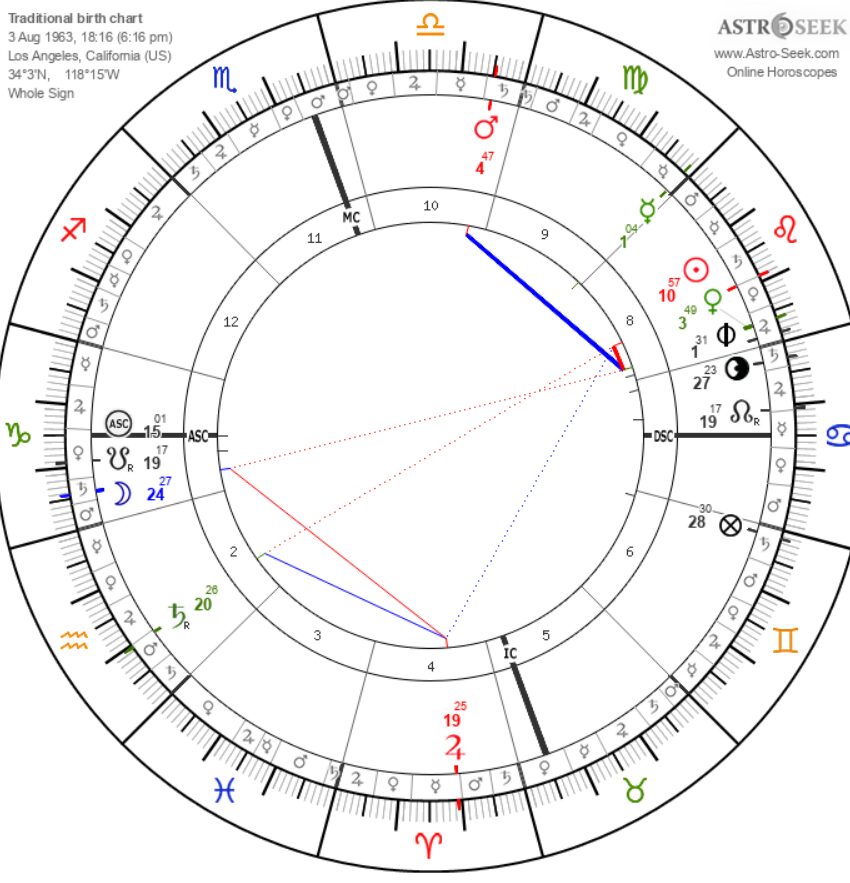
I. Capricorn Rising and the Rule of the Malefics
James Hetfield’s chart opens with Capricorn rising, which immediately points to a native born under the sign of material necessity, restraint, and concrete survival. Being a feminine, cold and dry sign, Capricorn indicates an incarnation marked by scarcity, hardness, and the need to build form and structure against resistance. At the same time, it is a cardinal sign, which implies initiative, organisation, and the imposition of order. This configuration also points to a structural fact: the two malefics exercise a determining power over the destiny. As ruler of the Ascendant and direct significator of the incarnation, Saturn becomes extremely important. Mars, because it is exalted in Capricorn, is likewise bound to the native’s image, body, and vital gesture. Life is, from the root, a field of tension between Saturnian containment and martial force.
II. Saturn in the 2nd House in Aquarius
Saturn is found in the 2nd house, the house of movable wealth, in Aquarius, its own domicile. Essentially, this is an extremely dignified Saturn, capable of structuring resources, systems, and material security in a methodical, strategic, and cold manner. It is through this Saturnian function that Hetfield tends to seek the satisfaction of his primary motivation, using a masculine and fixed sign associated with the fixation of knowledge, systems, and durable forms. This Saturn is accidentally retrograde and, above all, in applying opposition to the Sun domiciled in the 8th house in Leo. Here we have a frontal clash between two planets in their highest essential strength, but placed in houses of symbolic risk. The Sun in the 8th indicates an identity forged in territories of danger, loss, fear, vice, and confrontation with death or with limit-experiences. Saturn attempts to build stability and form in the 2nd, but is continually pulled towards the solar abyss of the 8th.
III. The Moon on the Ascendant
On the Ascendant we also find the Moon, applying, in Capricorn, in its detriment. Here we have two hylegical points in conjunction, which is technically very significant and makes the body and the life itself of the native extremely sensitive, reactive, and directly implicated in the movements of fate. The Moon is in its gibbous phase, therefore in a benefic-growing condition, which gives vitality and capacity for growth, but in a cold and dry sign, which creates a paradoxical mixture of sensitivity and hardness, emotional fluctuation and defensive containment. This makes the native’s vita vulnerable and rigid. The Moon’s only applying aspect is an opposition to Venus combust in the 8th in Leo.
Since the Moon is the universal co-significator of the unfolding of life, this causes the entire vital narrative to be repeatedly drawn towards the 8th house. We have here the clash of the two feminine planets of the zodiac, mediated by the Sun, which speaks of deep wounds in the affective, relational, and maternal sphere. As universal significator of the mother, the Moon in detriment, angular and tied by opposition to a house of death, points very clearly to a maternal presence that was strong, yet dry, contained, and marked by loss, which corresponds in a striking way to Hetfield’s biographical history.
IV – The Moon Ruling the 7th and Jupiter Structuring the 4th
Curiously, this same Moon, being angular, also rules another angular house, the 7th, in Cancer. This indicates that the field of relationships is governed by the same lunar principle that governs the body and life, which suggests that the native tends to find partners and significant figures who replicate, in one way or another, that fundamental maternal figure. Relationships become extensions of the primary emotional matrix. To this is added Jupiter angular in the 4th, in Aries, with dignity by triplicity of fire, which gives it real strength to found, expand, and structure a base, a family, or a “clan”.
However, this Jupiter is in square to the Ascendant, which indicates that the need for foundation and belonging enters directly in the identity and the path of life. The applying sextile between Jupiter and Saturn in the 2nd creates a true network of motivations between the construction of resources and the construction of a base, structurally linking the material economy to the family economy.
V – Mars in the 10th, Career, and the Corrosion of Bonds
Mars is an absolutely central piece in this chart. It is exalted in Capricorn, the very sign of the Ascendant, which binds it directly to image, body, and presence. However, it is placed in the tenth house, the house of destiny and realisation, in Libra, where it is in detriment. There is here a profound connection between the two strongest houses of the chart, the first and the tenth, mediated by a Mars that is simultaneously extremely powerful in manifestation and debilitated in condition.
This Mars rules the 4th, in Aries, and the 11th, in Scorpio, directly bonding career to the poles of family and friends. This describes a professional life in which conflicts, alliances, and ruptures with friends have a direct impact both on the career and on the emotional base. Mars, being angular, expresses itself in full, but being in Libra it does so in an unpredictable, strategic, and deeply corrosive manner. Martial force is not exercised directly, it must mediate, negotiate, calculate, play chess. The on-stage monster, martial-Capricornian, off-stage needs to sheathe the weapons and manage unstable equilibria. This points to a career marked by tensions with friends, significant losses, and structural conflicts, both in the 11th and in the 4th, bringing to mind individuals like Lars Ulrich, Dave Mustaine, James Newsted and Cliff Burton. The applying sextile between Mars and Venus combust in the 8th further binds creation, desire, risk, and self-destruction.

VI. Venus in the 8th, the Sun in Leo, and Mercury in Virgo
Venus combust in Leo, in the 8th house, is a very clear signature of desire corrupted by ego, of relationships marked by excess, secrecy, vice, and limit-situations. Combustion here also implies relationships that are hidden, conducted under the Sun’s rays, deprived of their own light and therefore unable to exist openly, especially dangerous in a house that already signifies death, fear, loss, and crisis. In Leo, this takes on an additional dramatic and egoic colouring: Venusian matters are crushed, overridden, and subordinated to an inflated solar will and identity. At the same time, this configuration can attract lust-ridden relationships that are drawn precisely to the force and magnetism of that ego, even when such attraction is structurally dangerous or self-destructive.
Moreover, since this Venus, combust by the royal Sun, also rules the 5th house in Taurus, a complex and very telling link is established between loss, risk, and creative expression. Themes of danger, excess, and existential exposure become, in a very real sense, fuel for a Taurian creativity so that what destroys and what inspires are never entirely separate in the native’s life. Death Magnetic, quite literally.
The Sun, extremely strong in its own domicile, indicates that the native’s identity is built precisely on those dangerous frontiers, those zones where life and death are at stake, literally burning the Venusian principle under its rays and clashing, by applying opposition, with Saturn in the 2nd. Since the Sun is exalted in Aries, this solar principle also projects its force into the fourth house, potentially impacting the domain of family, roots, and private life, and linking identity, excess, and crisis to the foundations of the native’s inner and domestic world.
For its part, Mercury is also extremely strong, domiciled in Virgo, in the 9th, without aspects. Although it is in a cadent house, the 9th is the best among them, and Mercury here is in its own throne, operating with maximum technical and discriminative power in the house of God, doctrine, and ultimate meaning. This does not merely indicate something “private” or “isolated”, but an intellect profoundly devoted to the Divine, the above, approaching it through analysis, study, distinction, and constant examination from every possible angle.
The relationship with God is mental and ascetic. Faith is something to be understood, purified, and worked upon. The absence of aspects gives this function a certain isolation and self-sufficiency. But Mercury is often a natural significator of religion and theology and, placed here in the ninth, it points to a fundamentally sound, structured, and potentially very healthy relationship with higher philosophy and theological thought, much more coherent and ordered than the native’s public life may suggest. It can also very concretely signify a master, teacher, or religious-intellectual authority figure who plays an important formative role in the native’s life.
Conclusion
Hetfield’s chart is that of a life in which practically all seven planets are angular and/or in essential dignity, connected by applying aspects, which indicates an existence of enormous intensity, where the seven classical forces manifest in a full, concrete, and inescapable way, in successive chapters of construction, conflict, loss, and reconstruction.
Kύριε ελέησον