

The 4 of Cups belongs to the element of Water, therefore to the plane of Briah, the sphere of Creation and Emotion. As a four, it closes the Pythagorean cycle initiated by the Ace (as Yod י and Monad), continued in the Two (as He ה and Dyad), and in the Three (as Vau ו and Triad). Then comes the Tetrad, which manifests the Cosmos, fixes the expansion of the three previous stages, and organises the vital current into structure; it is the moment in which the pattern descends into form, corresponding to the second He ה of the Tetragrammaton, the phase of material manifestation, the world made visible, the Mirror where the emanation recognises its outline.
This is why it is frequently associated with the square, a figure that contains, limits and circumscribes energy. On the emotional plane, this containment is expressed as a closing of the creative current, an interior suspension that many interpret as boredom or self-absorption, although the symbol is far subtler than that immediate reading.
In the Minor Arcana, the four always brings the cardinal decan of the element to completion. The first three decans belong to the cardinal sign, the second three to the fixed sign, and the third three to the mutable sign. Thus, 4, 7 and 10 are cards that seal ternaries, stages that close a movement and consolidate a force. The 4 of Cups is Moon in Cancer, the point at which Cardinal Water gathers the impulse initiated by the Ace and inscribes it into its matrix.
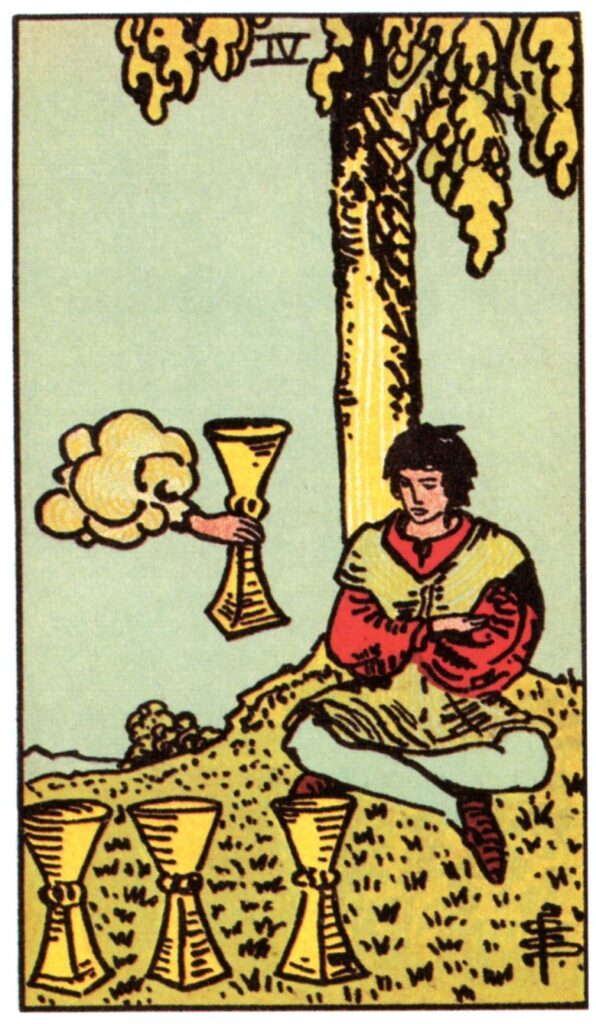
The Moon in Cancer expresses its own nature in a pure state. In geomancy, it corresponds to Populus, a figure in which Fire, Water, Air and Earth are all passive. This structural passivity does not necessarily imply inertia. It also signifies an absolute capacity to absorb, to receive, and to adapt to whatever moves around it, just like water itself. In the zodiac, Cancer coincides with the Nadir, with midnight, the roots of the Imum Coeli, the deep axis of the Fourth House that supports the entire Wheel. The 4 of Cups reflects this matricial point: it gathers the preceding emanation, extinguishes the excess, decants the impetus, and prepares the invisible ground in which the next act of will is to take form.
The so-called apathy of this card must be understood in an older and more rigorous sense. The Greek apatheia (ἀπάθεια), composed of a (privative) and pathos (passion, affect, disturbance), does not describe emotional indifference. It designates the capacity to sustain consciousness without being carried off by the tides of desire, fear, expectation or aversion. In the Stoics it is a condition of inner freedom, the state in which the five senses cease to dictate the direction of the soul and become instruments of a unified focus.
Applied to the 4 of Cups, this apatheia is lucid containment, the moment in which Cardinal Water holds its movement so as not to lose it through dispersion. It is the the bottom of the well where the reflection stops trembling. This clarifies why the four always prepares the five: it stabilises enough psychic matter for the ensuing martial blow to have something real to cut. Without this prior condensation, the five would be loose noise, pure loss, instead of an operative and workable wound. The 4 of Cups is much more than mere emotional dullness, being the stage in which emotion becomes dense and organic enough, ready to undergo the metamorphosis imposed by the next arcana.
Kύριε ελέησον