
Today, the New Moon in Sagittarius opens a paradoxical cycle for the nocturnal luminary. The Moon, cold, moist, and phlegmatic by temperament, belongs naturally to the lower half of the zodiacal wheel: it rules the Cardinal Water of Cancer, where it nourishes and protects, and it is exalted in the Venusian Earth of Taurus, the second house, where it ripens and gives form. Both signs belong to the lower hemisphere, the realm of interiority, roots, body, and gestation. Its nature is receptive, condensing, and devoted to the preservation of life through memory.
In Sagittarius, however, the Moon finds itself in a contrary climate, one that is mutable Fire, hot and unstable, where fluidity evaporates and the instinct to conserve is replaced by the urge to ascend. It is a cadent house, a place of synthesis rather than initiation or fixation, which endows the Moon with a restless and feverish tone. Under the rulership of the diurnal benefic Jupiter, hot and moist, the Moon acquires an ardent inquietude, becoming errant, airy, fascinated by height and detached from the matter of which it is made.
This displacement is deeply symbolic. Sagittarius is the first of the transpersonal signs, where the human impulse begins to reach beyond the confines of the intimate. The Moon, which prefers the lower half of the Wheel (where we find Taurus, Gemini [living in the so-called “House of the Goddess,” sacred to her] and Cancer, her own throne), is here compelled to gaze upon the world from above. Her usual mirror transforms into an arrow. In the Tarot, this tension is figured in the Nine of Wands, the card associated with the lunar decan of Sagittarius: a weary warrior holding the torch at the limit of his strength, symbol of perseverance at the end of a cycle. The Moon in Sagittarius manifests as a Moon in combat with her own element, more solar than nocturnal, more word than sap.
But this lunation carries within it a principle of reconciliation. Jupiter, ruler of the New Moon, is retrograde and exalted in Cancer (the domicile of the Moon), creating a mutual reception between them. The silver of the Moon and the tin of Jupiter exchange their properties: the Sagittarian fire receives the nourishing moisture of Cardinal Water, and Jupiter’s retrogression tempers the drive for expansion with a call to inwardness. This reciprocity builds a bridge between above and below, reducing errancy and transforming it into a more meaningful quest.
There is also a cyclical anomaly that reinforces this symbolism. Since the two consecutive New Moons in Virgo last September, the lunar rhythm has been subtly displaced from its usual axis. This New Moon rises in Sagittarius (the ninth house of horizons and faith), but the following Full Moon, on January 3, will not take place in Gemini as expected; instead, it will bloom in Cancer, the Moon’s own throne. This inversion hints at a symbolic correction in the celestial rhythm: the wanderings of fire lead once again to the watery dwelling of memory.
The decan in which this new lunation takes place belongs to Saturn in Sagittarius, ruler of the Ten of Wands in the Tarot, a card of exhaustion and the fulfilment of duty. It marks the closing of the fiery cycle before the winter solstice. Yet, as with every New Moon, this is a cazimi, the moment when the Moon is in the very heart of the Sun. This instant of purification and beginning therefore welcomes a double infusion of heat: on one side, Jupiter, ruler of Sagittarius, is hot and moist; on the other, the Sun itself resides in a fiery sign where it holds diurnal rulership by triplicity, making it comfortable and vigorous rather than weakened.
The Sun–Moon conjunction within this Saturnian decan of Sagittarius creates a sort of dense luminosity, the moment when fire gathers itself before withdrawal. Saturn, as ruler of the decan, imprints a sense of limit, structure, and purification, through the distillation of what has been learned. The Sun, about to reach its lowest point on the annual horizon, prepares to rise anew; the Moon, immersed within that solar heart, extinguishes herself to be reborn alongside it.
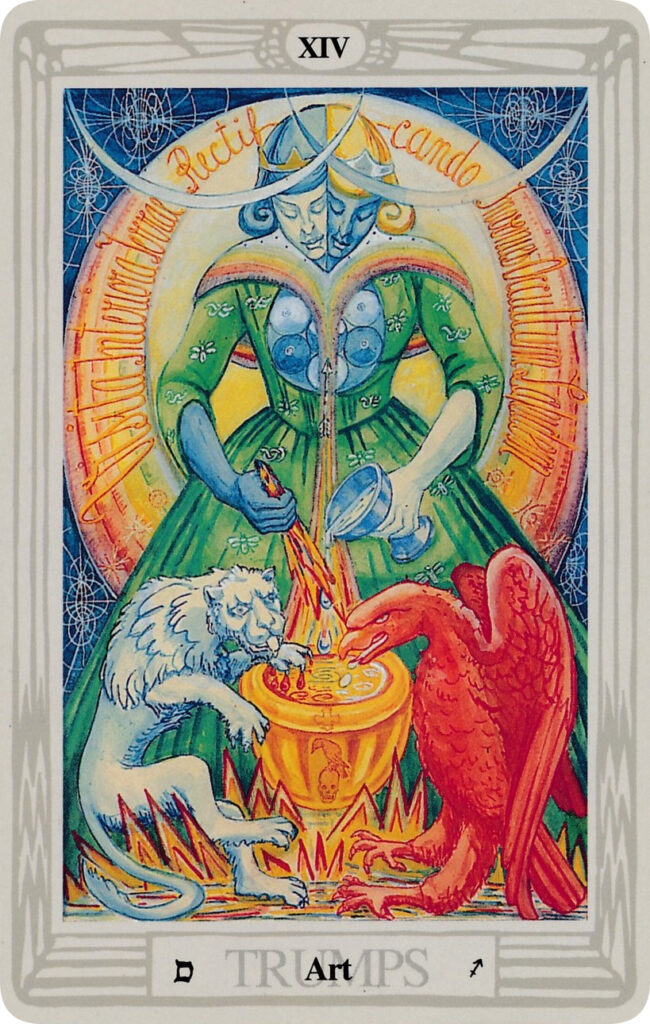
On the Tree of Life, the path of Sagittarius is precisely the one of Samekh (ס), which unites the receptive lunar Yesod and the active solar Tifereth. This is also the Arcana XIV, Temperance, the art of blending fire and water, the sacred marriage of opposites, and one of the four cardinal virtues. And, in this particular lunation, which culminates not in Gemini but in Cancer, that union, the coincidentia oppositorum, is made literal: a New Moon in the mutable fire of Sagittarius, fulfilled in the cardinal waters of Cancer.
Kύριε ελέησον