
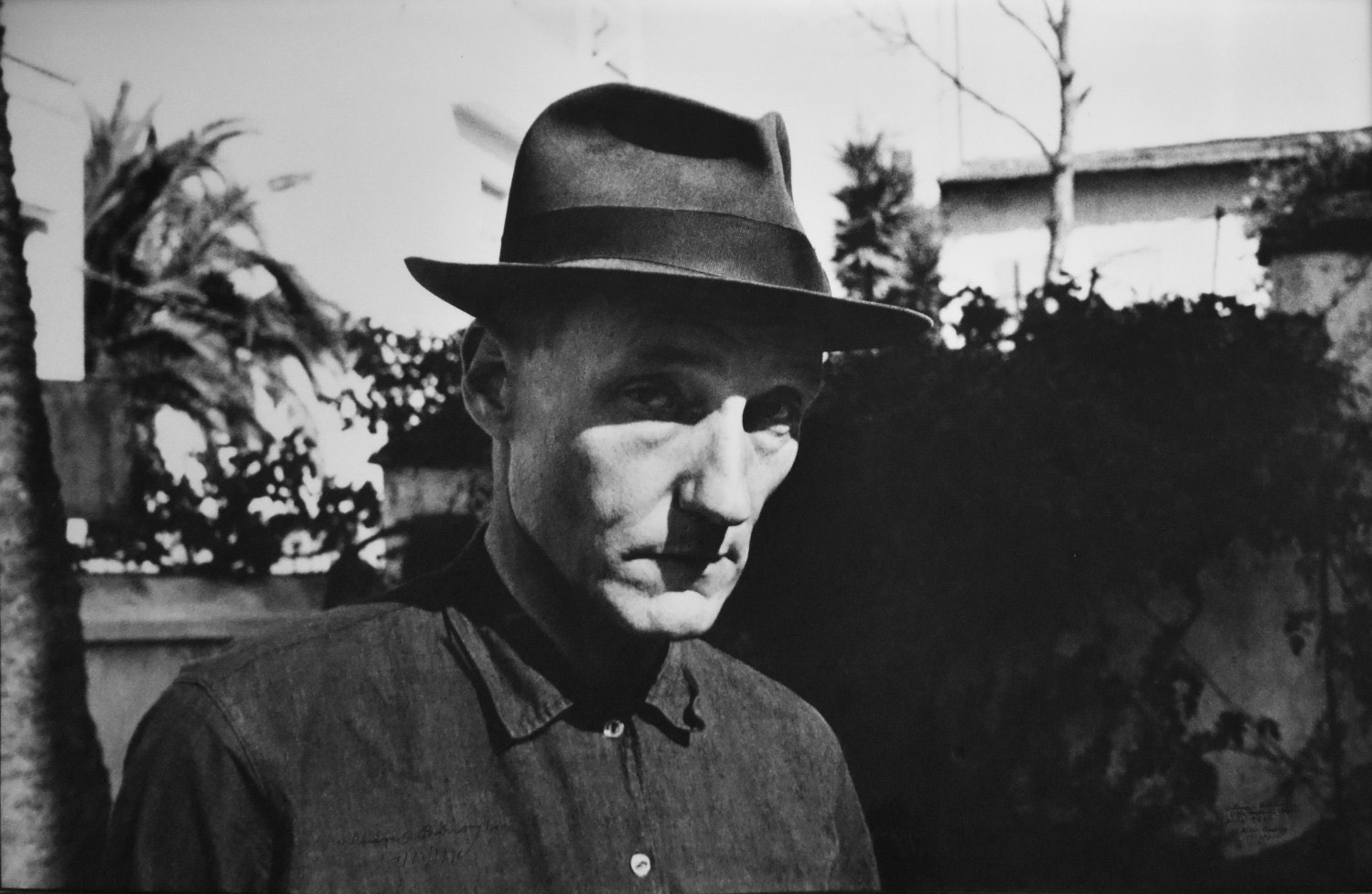
Today is the birthday of William S. Burroughs. The author of Naked Lunch leads us directly toward the universe of addiction, American and Mexican skid rows, and pleasure as an existential axis and as a method of exploring reality, metaphysics and magic. Let’s take a look at his chart.

The stellium in the 12th house is immediately visible. But the 5th house tells us something too. The 5th house is pleasure, sex, luxury, entertainment, play, vital discharge. In Burroughs, the 5th house is Cancer, a cold and moist sign, tied to sensation, bodily memory, attachment, and emotional needs. Pleasure functins similiar to anaesthetic here.
Mars is in this house. And Mars in Cancer is in fall. He does not like it a bit. The hot and dry planet, whose nature is to cut, separate, act, and fight, finds itself in a sign of opposite temperament. The martial energy becomes distorted and corrupted. Moreover, Mars is retrograde. This indicates repetition, return to the same point, like a drunk soldier who shows up at the same cabaret over and over again. Applied to the 5th house, it is pleasure as a closed circuit and that generates dependency. This Mars also impacts the creative side of the 5th house, because it’s the one where artistic production comes from.
Sure, we could look to the Moon as ruler of Cancer. But, in medieval astrology, position is stronger than rulership. It’s a golden rule. The planet occupying the house directly shapes the matters of that house. The Moon may say somethin about how the matter ends, but it is Mars that defines the whole narrative of the 5th house. And this Mars is weak, twisted in its quality. Pleasure, sex, play, and creation are marked by self-destruction.
Now let’s examine what this Mars rules in the chart because we want to see what other stuff this malefic influenced. Mars rules the 2nd house in Aries. The 2nd house is moveable possessions, money, and means of subsistence. The same planet that corrupts the house of pleasure also contaminates the relationship with resources. This fits Burroughs’ biography. Despite coming from a wealthy family, he spent much of his life in dissipation, dependent on inheritances, allowances, help from others, and improvised means.
Mars also rules the 9th house in Scorpio. The 9th house is God, metaphysics, philosophy, meaning, doctrine, intellectual pursuits, and teachers. So, the same planet that shapes addiction also governs Burroughs’ relationship with higher knowledge. Spirituality combined with sewers. The search for meaning occurs in poisonous territories. A metaphysics emerges in which the Divine appears as absence, corrosion, and silence. A dark, almost nihilistic sort of apophaticism.
Naturally, Burroughs became interested in magic, shamanism, marginal occultism, and practices outside any orthodoxy. For Burroughs, language was also a virus and a spell. His obsession with cut-up, textual collage, and syntactic fragmentation came from that. He believed that breaking sentences apart and recombining them could break patterns of mental and social control, which we could call egregores. This is classical magical thinking. With the Word as sigil.
Again, Mars ruling the 9th house in Scorpio. Poisonous, subterranean, experimental, anti-orthodox spirituality. When Mars is in the 9th, or rules it, the native hates organized religion. That’s a classic in traditional astrology. No churches, no dogmas. Knowledge torn from the bone, with the 9th ruled by a planet in fall and retrograde, installed in the house of tainted pleasure.
Let’s check the stellium in the 12th now. The planet closest to the cusp of the 12th house is Jupiter. The planet nearest the cusp is the most relevant within that house. Jupiter in Aquarius is dignified by triplicity of air. Its sanguine, hot and moist temperament is line with the sign, which is also sanguine. It is a functional Jupiter, operative. It is under the beams by separation, but already in recovery, almost at full strength.
The 12th house is prison, self-sabotage, hidden enemies, fear, and isolation. To have the greater benefic dignified near the cusp indicates structural protection in extreme situations. Not redemption. Not salvation. Minimal protection. Like having a fellow prisoner who has your back. This is visible in Burroughs’ life. Decades of heroin use. Violent environments, constant movement between countries. Arrests. Extreme episodes. Many of his contemporaries died young. He did not. Something held the structure together, even in territories related to chaos. That something is Jupiter in the 12th.
Finally, Mercury. Mercury is still connected to the 12th house, but it is conjunct the Ascendant. Technically, within the 5-degree zone of anticipation of the 1st house. It operates as a 1st-house planet, and Mercury has its joy in the 1st. It shaped the entire person of Burroughs. In Aquarius, dignified by triplicity, even if combust by separation, it is a workable and smart Mercury.
Mercury is also the planet of thieves, tricksters, and rogues. Because it is simultaneously connected to the 12th and the 1st houses, and because its proximity to the Ascendant makes it formative of character, Burroughs’ mercurial and discursive capacity also knew how to speak at the right moments in order to get out of trouble. Not merely to write, but to negotiate and slip through cracks. Hermes always knows the password.
The same Mercury allowed him to translate everything he lived into the written words. It is the planet of the scribes, after all. This is the that made Burroughs Burroughs. He possessed the capacity to convert extreme experience into language. Mercury glued to the Ascendant gave him a distinct voice, a recognisable style, and the ability to structure chaos into text.
The episode in which he shot and killed Joan Vollmer during a drunken game of “William Tell” illustrates this with brutal clarity. An act typical of Mars in fall, tied to pleasure, alcohol, recklessness, and self-destruction. Burroughs himself stated that he only became a serious writer after this event.
Kύριε ελέησον