

Fyodor Dostoevski died 145 years ago. When we look to his birth chart, we are struck right away by the brutal conjunction of Jupiter and Saturn, both retrograde, in the angular 4th, and in a choleric sign like Aries that Saturn abhors. The expansion and faith of Jupiter are crushed by weight, fear, and existential gravity. Then there is a leonine Mars, intensely choleric, in the 8th house, the place of death, terror, accidents, and nameless anguish, right next to the South Node which amplifies anything that is negative. But let’s focus on Mercury, the significator of his mind, because there’s a lot to say about it.
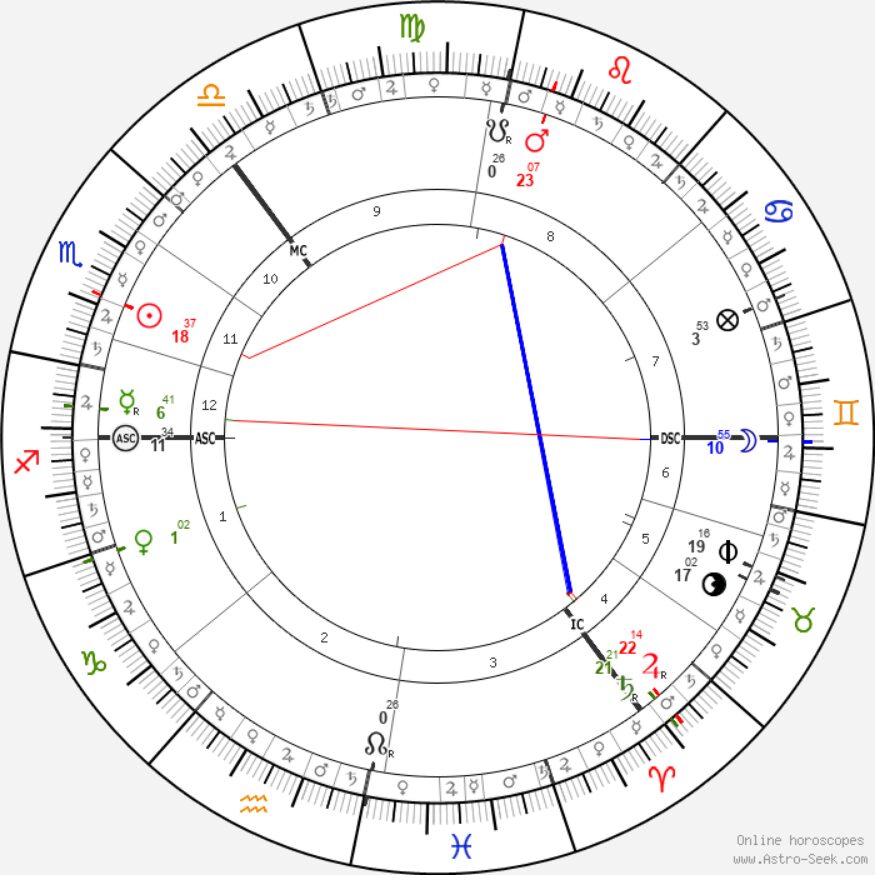
Mercury, planet of intellect, language, reasoning, and the articulation of Logos, is in Sagittarius, its detriment. Sagittarius is hot and moist, expansive, inflamed. Mercury becomes too fast for itself, hypertrophied, over-extended. In Tarot, Mercury in Sagittarius is the the 8 of Wands, the plane of Will at maximum velocity. The mind cannot rest. Mercury is a planet that enjoys all that is rational, analysis, and exactitude, but in Sagittarius loses the time and ponderation needed to do his calculations. This already describes Dostoevsky’s torrential mental life, the relentless inner monologue or feverish dialogues.
The condition worsens when we see Mercury’s accidental state. It is retrograde, so thought becomes ruminative, circular, returning obsessively to the same points, incapable of true forward motion. There is a further technical cruelty too. Mercury is five degrees away from Ascendant, but, since it is retrograde, it is moving back into the 12th house. It is painfully close to the house where Mercury finds joy, the 1st, but it is scared from it, so it steps back. It is as if Mercury is dreading the idea of helping the life and vitality of Fyodor, so he walks back into the most anti-life place of the zodiac to punish him.
The 1st house is the house of life, incarnation, ingenuity, the engine of existence. The 12th, cadent from the 1st, is anti-existential. It is the house where energy turns against the native. It signifies hidden enemies, self-undoing, confinement, vices, chronic illness, and visible or invisible imprisonment. So his Mercury does not serve life. Thinking works in favor of corrosion, fear, anticipation of catastrophe, fixation on guilt, hidden enemies, ghosts, and dissolution.
Mercury is triply debilitated: in an excessively choleric sign, producing explosive and over-heated rationality; it is retrograde, so it makes thought circular and compulsive; and lives in the 12th house, orienting the mind towards what wastes the vital breath. This describes a mental process inclined to depression, pathological anxiety, obsessive ideation, vices, and an almost magnetic attraction to themes of sin, punishment, and expiation. This is only intensified by the fact that Mercury rules the 9th house in Virgo, the house of God. His entire theological orientation was filtered through this sick Mercury. He attempted to reach the Divine through the rational, insisting on analysing God with the full weight of Virgo’s melancholic precision, critical severity, and obsessive discernment.
Let’s focus on the 6th house now, the one of acute illness, daily wear, and servitude, where we find the Moon in Gemini. However, since she is only one degree away from the Descendant cusp, she ought to be considered already angular 7th. A sanguine Moon, mutable, nervous, overstimulated by mental processes too. Emotional states shift rapidly, with mental and emotional cycles repeating. Dostoevsky suffered from epilepsy, a neurological condition profoundly tied to rhythm, sudden discharge, and loss of control. The Moon governs cycles and, in Gemini, these same cycles become nervous.
Gemini is ruled by Mercury. And that Mercury, as we have seen, is retrograde in Sagittarius in the 12th. The house of acute illness and serfdom is tied to the most afflicted planet in the chart. Also, Moon and Mercury are in opposition, the worst aspect of all, as both planets are with their backs to each other, the emotional against the rational. On the Gemini side, nervous, repetitive emotional patterns. On the other, obscure, ruminative, self-destructive thoughts. In medieval astrology, few things are more damaging to physical and mental health than a strong connection between the 6th and 12th houses.
Dostoevsky was sentenced to death and reprieved at the final moment, an experience that scarred him. He spent years in Siberian penal servitude, living under conditions that perfectly mirror a sick 6th. He battled illness, epileptic seizures, poverty, debt, and a lifelong gambling addiction, behaviour entirely consistent with an ungoverned Mercurial principle in Sagittarius, perpetually going after a Jupiter miracle that never stabilises.
Dostoevsky’s genius managed to do extraordinary literature from this inferno. The same structure that condemned him to suffering also gave him unparalleled insight. Mercury violented him until the very end. If the cliché of the tortured artist is true, then his birth chart shows that in his case it is literal.
Kύριε ελέησον