When the Portuguese philosopher António Telmo said in an interview “the ideas I have come from the angels”, he was making a precise ontological claim: thought is not private property of the ego.
The human intellect operates as a receptive organ. Just as the eye does not create light but receives it, the intellect does not manufacture fundamental ideas. It apprehends forms that exist on a higher plane of reality and bring them down. This plane may be called intellect, the Nous, the angelic world, the realm of forms, the Divine mind. The vocabulary varies but they point to the same source.
In the Nile floods in Ancient Egypt, long before geometry existed as a discipline, Egyptian civilisation lived already according to a principle of measure. The river overflowed, fields were erased, boundaries disappeared. Then, land had to be re-established, divided, proportioned, restored. Measurement emerged because order was already present and required rediscovery after each inundation. The principle of measure precedes the technique of measuring.
This places the human being in a radically different position from the modern one, where they become an interpreter, a translator. An imperfect copyist of a library that infinitely precedes him. We just need to meditate on Tetragrammaton to see this with clarity. The second He, associated with the dense material plane of Assiah and with the element Earth, is precisely the point at which the other three principles (Yod, He, and Vau) are translated and coagulated. What exists above is received, fixed, and given form below. So, when António Telmo formulates the idea, he is directly rejecting the Cartesian paradigm. He does not say “I produce ideas”. He says “ideas come to me”. The centre of intelligence, instead of being sealed inside the skull, it is open to Being.
This is the same logic that sustains the question “what is this?”. Because if ideas are not mine, then the thing possesses its own identity. I approach it in order to discover, not to project my meaning onto it. By contrast, modernity begins from the opposite assumption. Ideas are generated by the brain. Thought is a neurological secretion. Therefore everything I think is mine. Therefore the world becomes a screen onto which I project internal content.
Telmo is affirming something far older and more demanding. Thinking is an act of humility. To think well is to align oneself with an intelligence that does not belong to me but is above me. This also explains why knowledge and ethics are never separated. If I deform my character, I lose the capacity to receive true forms. I become a warped mirror that fails to reflect the light from above. This is why there is so mch insistence in the tradition on discipline, purification, silence, and asceticism. The instrument needs constant fine-tuning.
When reciting the Litany of Humility, we are resorting to a very ancient spiritual technology, inherited from the same metaphysical horizon that holds that the human being is not the source of meaning, but an antenna. Each line of this prayer works directly upon the point where the modern ego installs itself as sovereign centre and then pushes it off the throne.
Asking to delivered from the desire to be esteemed, preferred, praised, or approved is acting upon that which most interferes with the capacity to perceive. The desire for centrality creates an inward curvature. Everything becomes interpreted through the image of ourselves. The world ceases to be heard as it is and begins to be translated according to what confirms, threatens, or feeds our ego. With this, even when something true presents itself, it appears distorted.
Consider also the etymology of analogy, as it points directly to a form of knowing that has almost disappeared from modern consciousness. The Greek analogía is formed from aná (according to, in conformity with) and lógos (ratio, measure, relation, intelligible principle). Logos is the metaphysical ordering intelligence through which reality is structured and made intelligible. At its root, analogy means “according to a measure” or “according to a proportion”, understood as “according to the Logos”. It designates a mode of thinking and knowing in which the intellect apprehends proportional relationships between different orders of reality because those orders participate in a single intelligible source. When we know by analogy, we perceive that distinct things share the same underlying ratio, the same formal structure, even when their appearances differ.
This is why the image of the human being as an antenna is important. An antenna receives a signal by aligning itself with a frequency that exists already. In the same way, analogical knowledge depends on alignment with proportion. The intellect recognises which proportions exist and tunes itself to them. When it is correctly oriented, it begins to resonate with patterns that traverse multiple planes of being. The “correspondences” reveal themselves as resonance with a pre-existing structure.
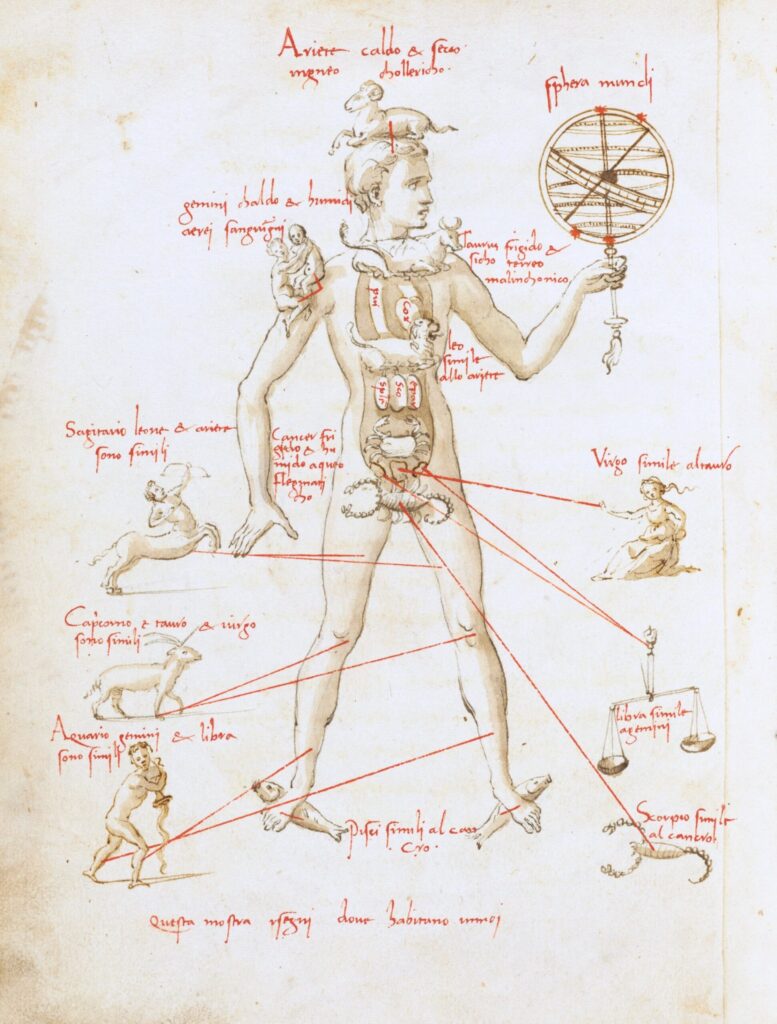
The world is a web of analogical relationships. Heat relates to fire in the same way that courage relates to Mars. The growth of plants relates to spring in the same way that youth relates to expansion. Saturn relates to old age and this to winter. The star Spica is part of the Virgo constellation and tied to the Virgin Mary. The four Gospels are related to the four fixed signs and these to the four elements and these to the four suits of the Tarot. These are structural readings and they work because reality is understood as organised by forms that repeat themselves across different planes of being. This is the core axis of traditional/medieval astrology, natural theology, and classical philosophy. Our task is only to become better readers, interpreters and translators of the Source.
Kύριε ελέησον