
There’s a strong case for using the 40 pips only for proper prediction and judgement in Tarot. Divination must be as simple as possible, in all its forms. When you get proper experience under your belt as a horarist, you learn that the questions can be answered using almost always two or three significators only. There is no need for superfluous outer planets, asteroids and five hundred Arabic parts. Less is more is the cornerstone of divination forms. Too much information is not what you need when you are reaching the Divine for an answer. It just creates background noise. The principle of Occam’s razor can and must be applied to divination.
And the same is true for Tarot. A proper divination methodology that can predict mundane, everyday things in our life combines perfectly with the 40 pips. The 22 major are much too abstract, too grandiose almost, and they open the way for what the new age crowd loves the most. Which is talking about internal processes, archetypes, karma and all that gibberish that does NOT predict anything about the future, it only keeps going around in circles about hypothetical inner issues without addressing the most pressing needs of life. I’m not saying they are useless, but I keep them to proper (and rare) spiritual probing, specific rituals, not to predict mundane occurrences.
On the other hand, the 40 pips works with the 4 elements via the four suits, the building blocks of manifestation in the material world. And we are in the material world, right? If we keep the 4 elements sidelined in divination, accuracy decreases dramatically. It’s also why horary astrology and geomancy are very much focused on the elements too. You can’t divine without Fire, Water, Air and Earth.
Then we have these four decks split into numbers from 1 to 10, which accurately represents the unfurling of the One (1) into the multiple (10) and back to the One, mirroring the ever-going continuum between the top (Kether) and bottom (Malkuth) of the Tree of Life, from the Source to the material manifestation. This is also signified by the theosophic sum 10 = 1 + 0 = 1. The eternal movement between the emergence of the element in the Ace until it reaches its conclusion in the 10, heading straight back to the Ace.
And, also from my experience, the Golden Dawn attributions of the 40 pips to the astrological Egyptian decans are accurate too. I very much agree with Agrippa when he says that a proper divination method must include astrology. We live in in the sublunar world and our fate is ruled by the 7 planets in all their interactions, being the enforcers of the Will of God. These decan attributions allow the 10 cards to be split into the 12 signs, another key numerological formula. As Robert Zoller says in his course: “Astrological tradition holds that all the species of all beings are in the stars and especially in the 12 signs of the sidereal Zodiac (duodecad) which veils the decad (10)”. And then these 12 signs are divided into its 3 modalities: cardinal, fixed, and mutable.
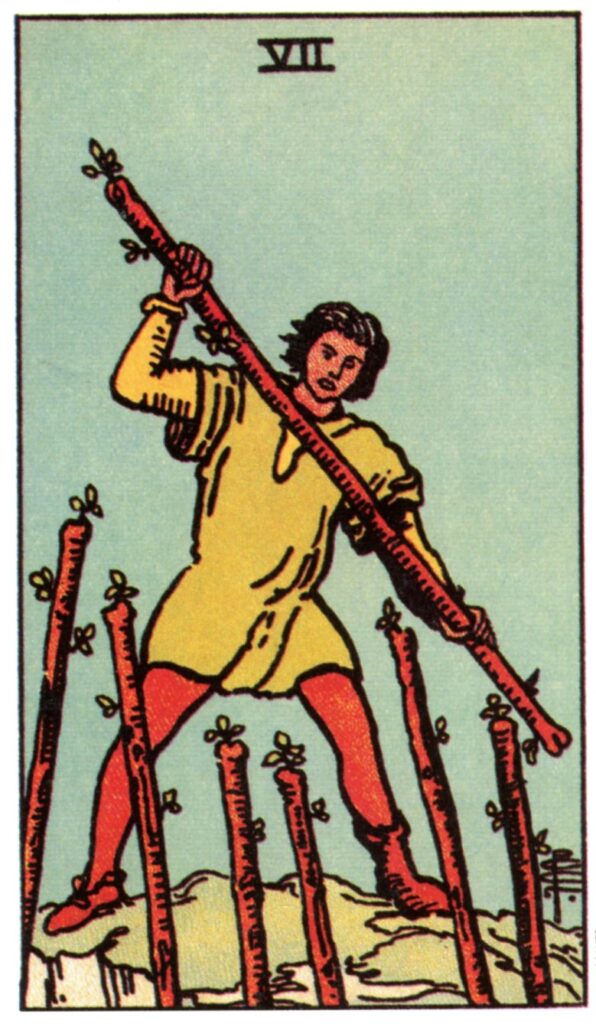
One thing is looking at the 7 of Wands, plain and simple. Another is to know that it is associated with Mars in Leo, the quarrelling malefic in a fixed sign. So you have: (1) the hot and dry planet who loves to fight and kill; (2) in a hot and dry sign like Leo which matches its nature; (3) in the fixed modality. Almost immediately you can infer that this incensed fighter, like a rabid dog, won’t let your arm go easily. It’s fixed. And then, from the number Seven, you know that this is a disruptive, Dionysian force that has just disrupted the ever-harmonious Six. So the Martial fighter also loves the contest in itself. Leo is also a quadrupedal sign, making Mars even more animalistic. A very good card to signify you when you need to defend your ground. A bad one when it signifies your opponent in a duel.
Then you just need to come up with a method/spread that allows you to interpret the interaction. Also here simplicity is key, otherwise you end up with 10 cards that contradict each other in all sorts of ways. I’m always remembered of Balinus, who in horary used only the four angles of the cross to reach an answer. Again, less is more!
You may be asking about the 16 court carts. I have come to stop using them also, for the most part. They are good at identifying the temperament of the people involved in a spread. Let’s say I want to know more about the querent and I get the Knight of Wands. The main element is Fire, the active choleric component together with Air, the active sanguine one. You have two active elements. The main one is all about action and the secondary is about thinking and planning. You get a choleric-sanguine temperament, a man with a plan, so to speak, completely disregarding the passive elements. Then the quesited gets the Queen of Cups, where the main and secondary elements are phlegm only. So you have a quesited who is full-blown phlegmatic, sensitive and prone to inaction, pitting against the Knight of Wands, with totally different temperaments. The court cards are then interesting as side info, but not as core tools for predicting events.
The 40 pips are enough!
Kύριε ελέησον